Guide

How to do anything in Sixth Man

Step-by-step help for everything in the app, from adding your first player to keeping the book on game day.

Getting started

Install the app, look around a demo team, and set up your own in about two minutes. No account needed.

Set up your team

The first time you open Sixth Man, tap Set up my team. Setup has six short steps, and every one can be skipped and changed later.

  1. Name your team: it shows on the scoreboard and in box scores. Skip it and the team is called “My team” until you name it.
  2. Pick your colors: two colors theme the whole app, in light and dark mode. See Change the team name and colors.
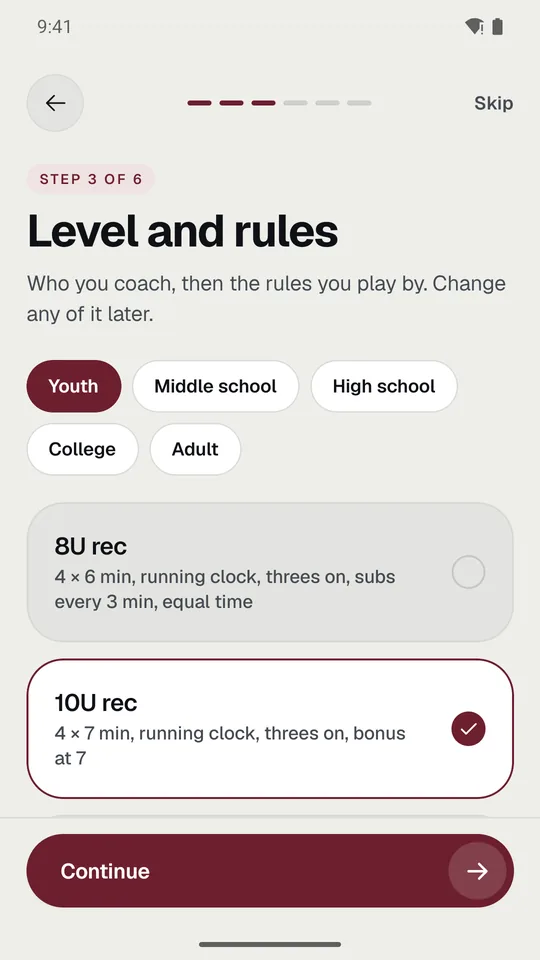
  3. Level and rules: pick who you coach (Youth, Middle school, High school, College, or Adult), then the rule template closest to your league.
  4. Who’s on the team?: a jersey number and a first name for each player. Use the keyboard’s Next key to move through the boxes; it adds a row when you reach the end. A name without a number is fine.
  5. Your next game: optional. Type an opponent, pick Home or Away, a date, and a time, and it shows on Home.
  6. Pick your extras: Schedule (on to start) and Parent contacts (off to start).

Tap Create team on the last step. You land on Home with your team on screen.

Tip

Skipping a step keeps what you typed, but skipping Colors goes back to the default colors, and skipping Level and rules uses Youth and 8U rec.

Team setup, step 3 of 6: the level and the rule templates.

Look around a demo team

A demo team is full of made-up players, finished games, and plays, so you can try everything before setting up your own.

  1. On the first screen, under Or look around a demo team first, tap Youth demo or Varsity demo.
    • Youth demo: the Demo Dragons, an 8U team that keeps points and fouls. The tour starts with it.
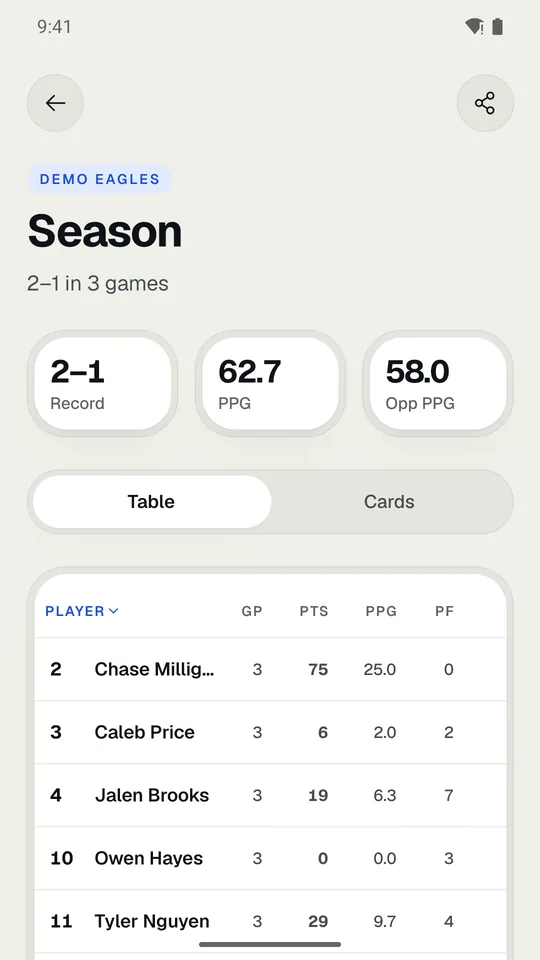
    • Varsity demo: the Demo Eagles, a high school team with three games kept with full stats and shot charts.
  2. Look around. Score a game, open the box scores, play the plays.
  3. When you’re ready, tap Set up mine on the demo card on Home.

A demo’s name, colors, rules, and roster are locked, and a demo never counts as one of your teams. To bring one back later, go to Team › Settings › Take the tour (Dragons) or Team › Settings › High school demo (Eagles). To remove one, see Delete a team.

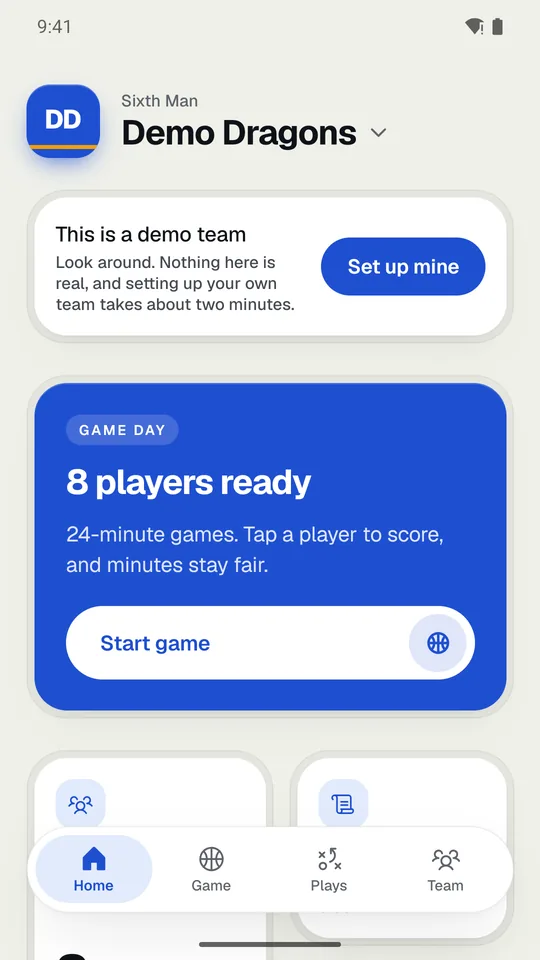
Home on the Demo Dragons, with the demo card at the top.

Take the tour

The tour is seven cards on the Demo Dragons. Each one takes you to the part of the app it’s about: Home, a box score, game day, a play, season stats, and Settings.

  1. Tap Youth demo on the first screen, or go to Team › Settings › Take the tour anytime.
  2. Tap Next and Back to move through the cards, or × to end it.
  3. On the last card, Make it yours sets up your own team. Keep exploring ends the tour.

Find your way around

Four tabs run along the bottom. On a tablet held sideways, they run down the left side.

TabWhat’s there
HomeYour next game, a live game to go back to, and shortcuts to the roster, rules, colors, and playbook.
GameStart a game, what’s up next on the schedule, and the game log of finished games.
PlaysYour playbook.
TeamRoster, Schedule, Practices, Attendance, Season stats, and Settings.

Settings is the gear at the top right of the Team tab (or the Settings row at its bottom). It has everything about how the team and the app are set up: stats, rules, colors, backups, and Pro. In this guide, a path like Team › Settings › League rules means: tap the Team tab, tap the gear, then tap League rules.

Tip

Settings has a search box. Type what you’re looking for, like “dark” or “bonus”, and it opens the right screen. See Find a setting.

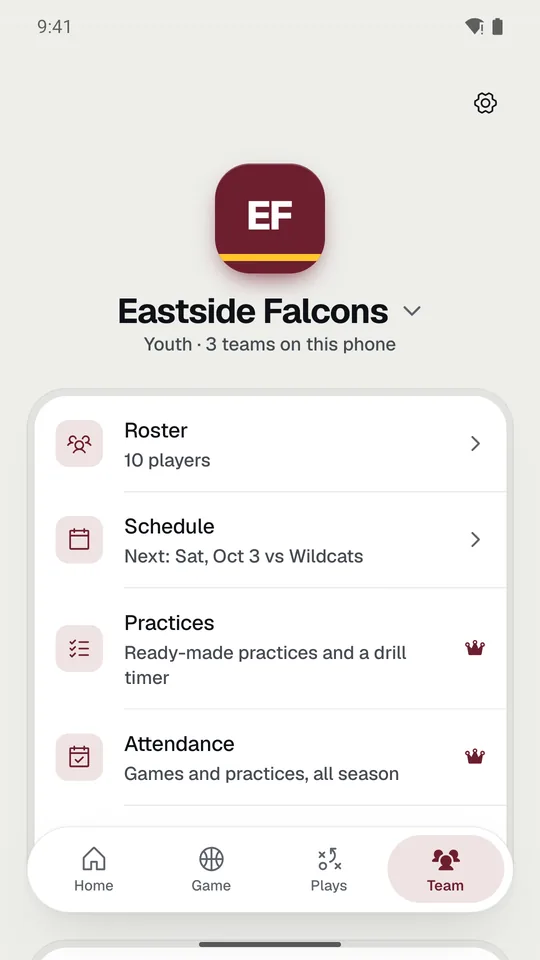
The Team tab: the team name, the places you use all season, and the Settings gear.

What’s on Home

  • The team name at the top: tap it to switch teams or add one.
  • The main card: what’s next. It’s Build your roster for a new team, your next scheduled game with Start game, or the live game with Resume game.
  • Tiles: Roster, Rules, and Colors open those screens.
  • Playbook: how many plays you have, and the latest one.

With the season pass, a card at the top lets you know before it renews or if a payment didn’t go through. On a tablet held sideways, Home also shows a Season card with your record and top scorers.

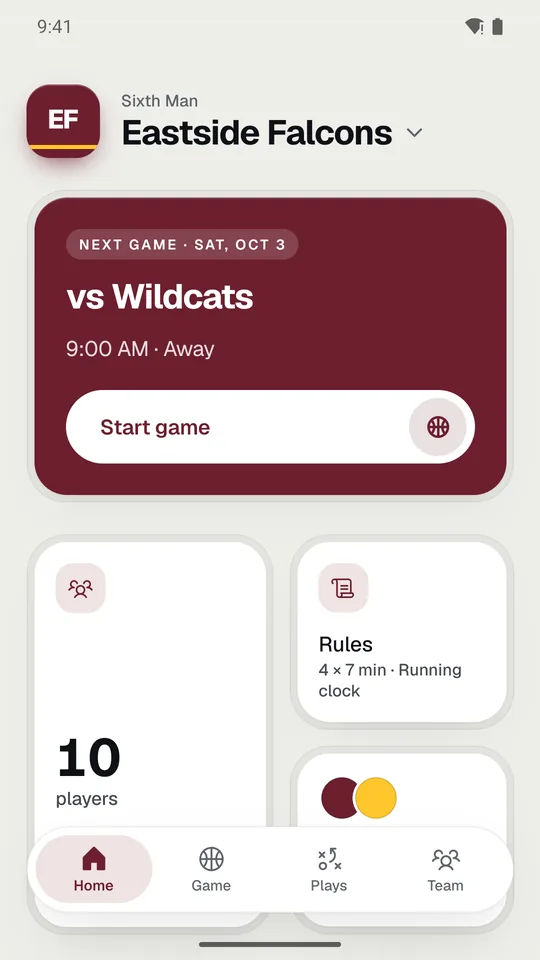
Home with the next game card and the roster, rules, and colors tiles.

Your team

Players, parent contacts, your team’s look, and more than one team.

Add a player

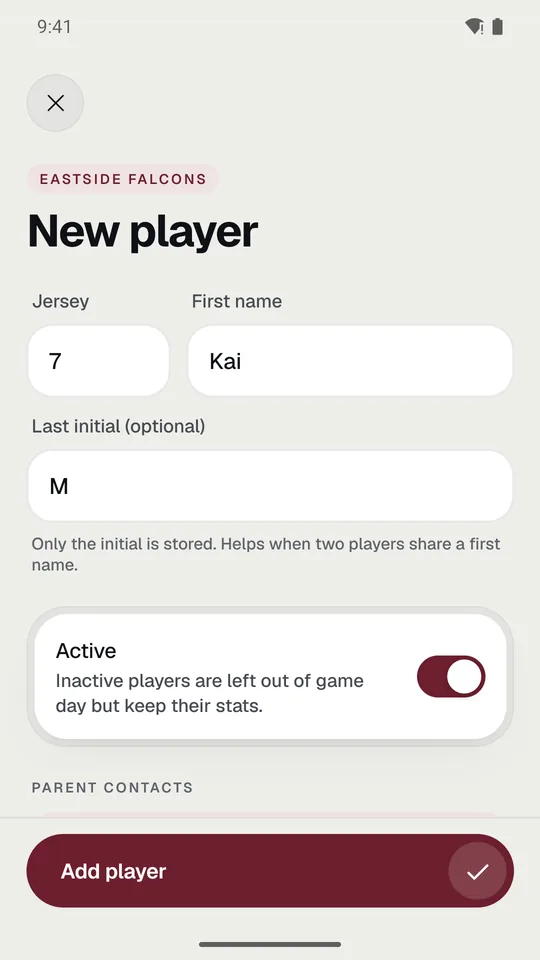
  1. Go to Team › Roster.
  2. Tap the person icon at the top right (Add player).
  3. Type the Jersey number. No number yet? Leave it blank and add it when the jerseys come.
  4. Type a First name. It’s the only box you have to fill.
  5. Add a Last initial if you like. With full names on, it’s Last name.
  6. Tap Add player.

If another player already wears that number, the app says so. Two players can share a number, but scoring is easier when every number is different.

Tip

Setting up a new team? Setup’s roster step takes the whole roster at once. Type a number, press Next, type a name, press Next, and keep going.

The New player screen with a jersey number and a first name.

Edit a player

  1. Go to Team › Roster and tap the player.
  2. Change their number, name, or contacts.
  3. Tap Save.

The roster sorts itself: active players by number, then players without a number, then inactive players.

Mark a player inactive

An inactive player keeps their stats but is left out of game day, attendance, and messages to parents. It’s the right choice for a player who left the team mid-season.

  1. Go to Team › Roster and tap the player.
  2. Turn off Active.
  3. Tap Save.

Inactive players move to their own part of the roster. Turn Active back on to bring them back.

Note

A player who’s hurt for one game doesn’t need to be inactive. See A player is hurt or goes home.

Show full names or last initials

  1. Go to Team › Settings.
  2. Under Features, turn Full names on or off.

With it on, players show as “Maya Rivera” in the roster, box scores, and PDFs. With it off, they show as “Maya R.” Youth teams start with it off; every other level starts with it on.

Players added with only an initial keep showing it until you type their last name. Play diagrams never show names, only numbers.

Add parent contacts

  1. Turn on the feature: go to Team › Settings and, under Features, turn on Parent contacts.
  2. Go to Team › Roster and tap a player.
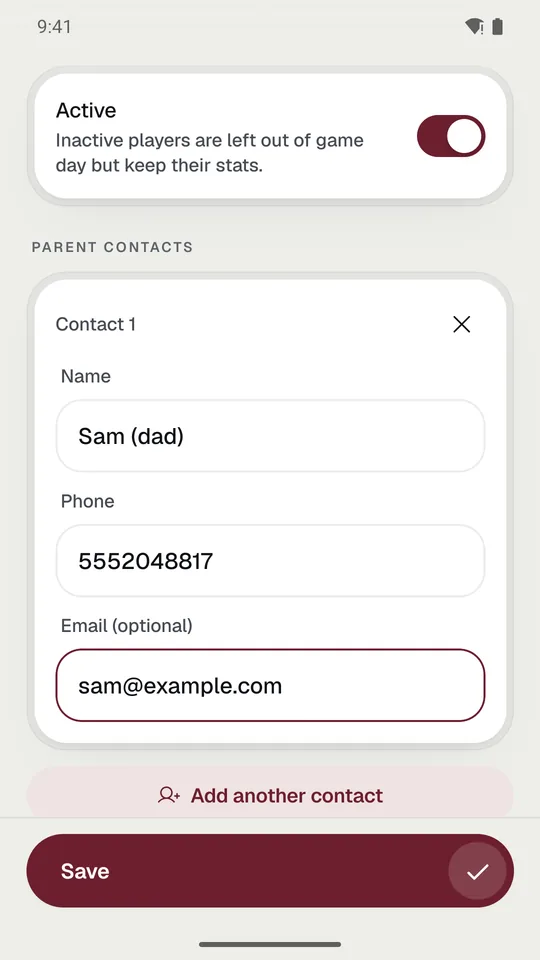
  3. Under Parent contacts, tap Add a parent contact.
  4. Fill in a Name, like “Jess (mom)”, a Phone, and an Email if you have it. Each player can have up to three contacts.
  5. Tap Save.

Parent contacts stay on your phone (and in your backup file). They’re never sent anywhere else.

A player’s parent contacts: name, phone, and email.

Text, email, or call parents

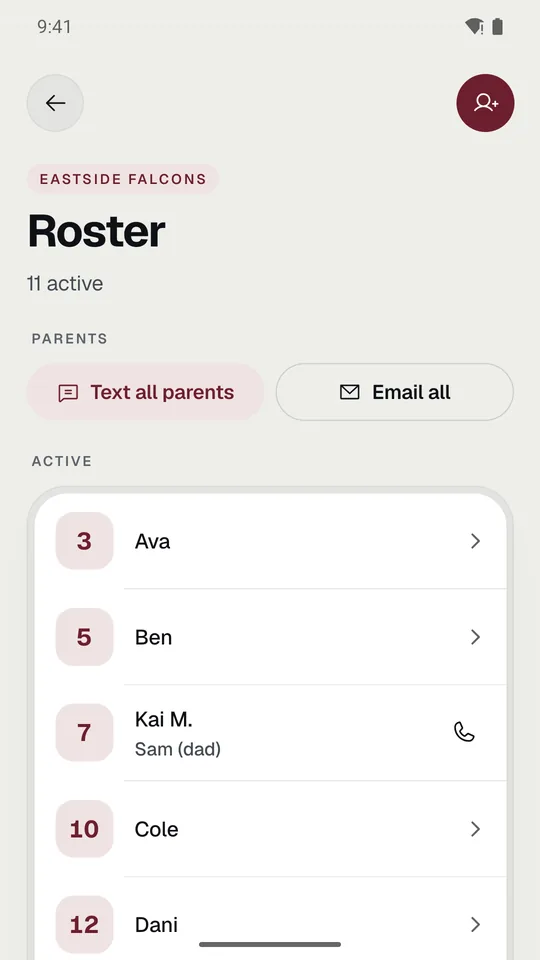
With parent contacts on, the top of Team › Roster has:

  • Text all parents: opens one group text to every active player’s contacts.
  • Email all: opens a new email with every parent in BCC.
  • A phone button on each player’s row calls their first contact.

Nothing is sent until you send it from your messages or email app. Inactive players’ parents are left out.

The roster with Text all parents, Email all, and a call button on each row.

Change the team name and colors

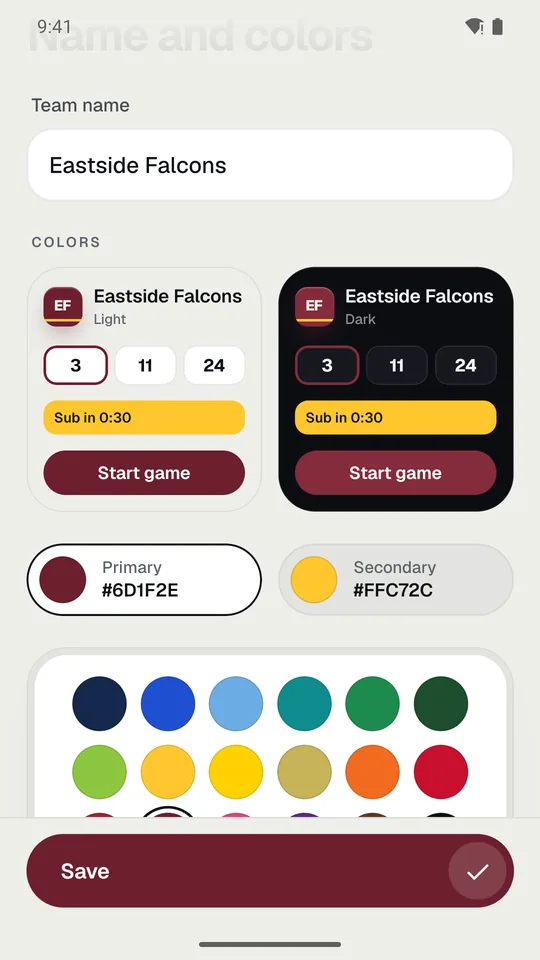
  1. Go to Team › Settings › Name and colors, or tap the Colors tile on Home.
  2. Change the Team name if you like.
  3. Under Colors, tap Primary, then a swatch. Do the same for Secondary.
  4. Have the exact colors from your jerseys or league site? Type the hex code (like #1f4fd1) in the box under the swatches.
  5. Tap Save.

The whole screen previews the new colors, in light and dark, before you save. If the two colors are hard to tell apart, including for people who are color-blind, the app says so; tap Adjust secondary to fix it. Every color is adjusted so text stays readable.

Name and colors: the two colors, the swatches, and light and dark previews.

Switch teams

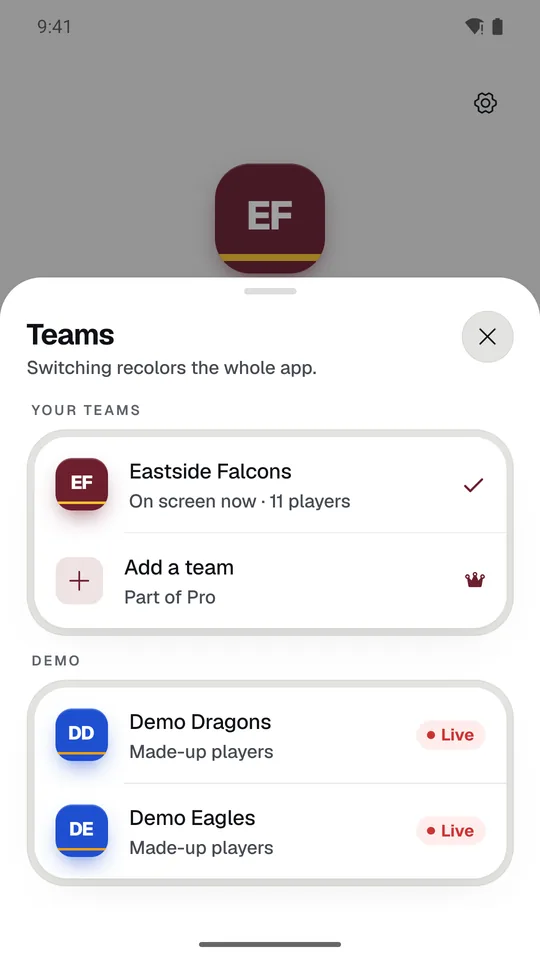
  1. Tap the team name at the top of Home or the Team tab.
  2. Tap a team. The whole app changes to its colors.

A team with a game going shows a Live tag.

The Teams sheet: your team, Add a team, and the two demo teams.

Add another team

  1. Tap the team name at the top of Home or the Team tab.
  2. Tap Add a team. The line under it tells you what it takes:
    • Name, colors, and rules: you have room, so setup opens.
    • Part of Pro: the free plan has one team. Pro opens; after you buy, setup opens.
    • 2 of 3 teams: Pro has room.
    • Team spot · $2.99: Pro’s three teams are used. See Add more teams with team spots.

Demo teams never count as one of your teams.

Delete a team

  1. Switch to the team you want to delete.
  2. Go to Team › Settings and tap Delete this team at the bottom of the team’s part.
  3. Tap it again to confirm.

Its roster, games, plays, and practices are erased for good; a deleted team doesn’t go to Recently deleted. Save a backup file first if you might want it back. You can’t delete your only team: add another one first. This is also how you remove a demo team.

League rules and stats

Nothing is hardcoded. Set your league’s periods, clock, timeouts, fouls, and subs once, and pick what the scorekeeper tracks.

Open League rules

Go to Team › Settings › League rules. You can also tap the Rules tile on Home, or League rules on the new game screen.

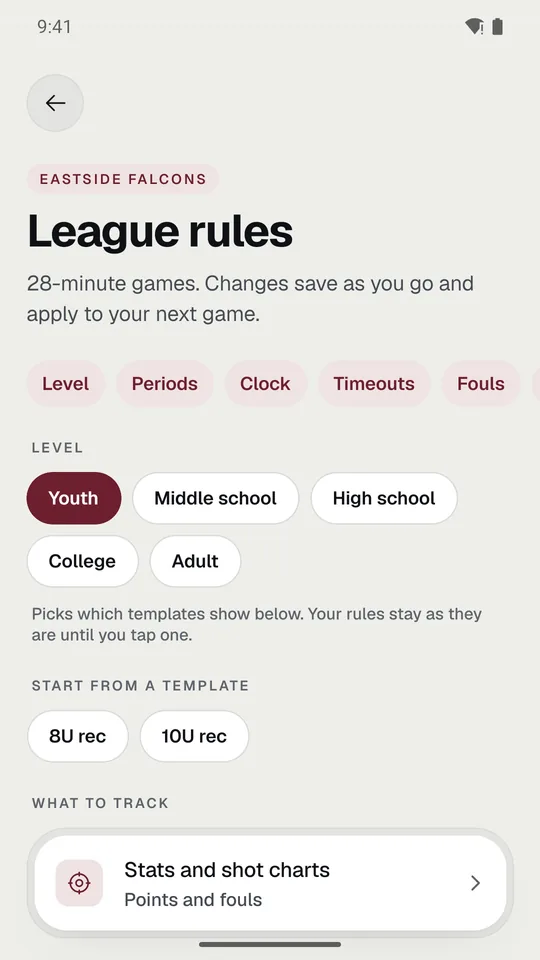
The chips at the top (Level, Periods, Clock, Timeouts, Fouls, Scoring, Subs, Playing time) jump to each part. Changes save as you make them; there’s no Save button.

Note

Each game keeps the rules it started with. A change here applies to your next game and never rewrites a game that’s already been played.

League rules: the chips at the top, the level, and the rule templates.

Pick your level

The level is Youth, Middle school, High school, College, or Adult (pro rules are under Adult). You pick it when you set up the team, and you can change it at the top of Team › Settings › League rules.

Picking a level shows that level’s rule templates. It doesn’t change any rules until you apply a template.

Start from a rule template

  1. Go to Team › Settings › League rules.
  2. Under Level, pick your level.
  3. Under Start from a template, tap a template, then tap it again to confirm. Every rule below is replaced with the template’s, including what to track.
  4. Change anything that’s different in your league.
TemplateGameClockFoulsStats
8U rec4 × 6 minRunningOut at 5, no bonusPoints and fouls; subs every 3 min, equal time
10U rec4 × 7 minRunning, stopped the last 2 minOut at 5, bonus at 7, double at 10Points and fouls; 10-minute minimum
Middle school4 × 6 minStopOut at 5, two shots from the 5th each quarterShooting
High school4 × 8 minStopOut at 5, two shots from the 5th each quarterFull stats and shot locations; three 60s and two 30s timeouts
College men2 × 20 minStopOne-and-one from the 7th, two shots from the 10thFull stats and shot locations
College women4 × 10 minStopTwo shots from the 5th each quarterFull stats and shot locations
Adult rec2 × 20 minRunning, stopped the last 2 minOut at 5, bonus at 7, double at 10Points and fouls
Pro4 × 12 minStopOut at 6, two shots from the 5th each quarterFull stats and shot locations

Set periods and the clock

In Team › Settings › League rules:

  • Periods: Game is played in Quarters or Halves, the length of each, and the Overtime length.
  • Clock: Clock type is Running, Stop, or No clock.
    • With a running clock, Stop the clock for the last sets how many minutes at the end of each period play as a stop clock. Off runs it to the buzzer.
    • With no clock, the app counts real time for players’ minutes.

Set timeouts

In Team › Settings › League rules › Timeouts:

  • Timeouts: how many 60-second timeouts.
  • 30-second timeouts: how many short ones. Off means every timeout is a full one.
  • Given per: Half or Game.
  • Unused timeouts carry over: shows when timeouts are given per half.

Set fouls and the bonus

In Team › Settings › League rules › Fouls:

  • Player fouls out at: 2 to 10, or Off so nobody fouls out.
  • Bonus starts at team foul: the team foul that starts free throws, or Off. On its own, it means two shots from that foul on.
  • Double bonus at: when it’s on, the bonus is a one-and-one and two shots start here.
  • Team fouls reset each: Half or Quarter.

The scoreboard shows each team’s fouls and marks the bonus when it’s reached.

Set threes, free throws, and the mercy rule

In Team › Settings › League rules › Scoring:

  • 3-pointers count: turn it off for leagues without threes. The +3 button goes away.
  • Free throws: turn it off for leagues that don’t shoot them.
  • Mercy rule: once a team leads by the margin you set under At a lead of, the clock keeps running through fouls. The score stays on screen.

Set players on the court and how subs happen

In Team › Settings › League rules › Substitutions:

  • Players on the court: 5, 4, or 3. Some younger leagues play 4 on 4 or 3 on 3.
  • How subs happen:
    • Anytime: sub whenever you like.
    • Shifts: set a Shift length, and the app tells you when each shift is up.
    • Each quarter (or Each half): new players every period.

Set a playing-time goal

In Team › Settings › League rules › Playing time:

  • Goal: Equal time, Minimum (set the minutes under Every player plays at least), or Off.
  • Warn when a player falls behind: during a game, the app tells you who’s behind.

With a goal on, box scores show each player’s minutes against the average, and season stats show each player’s fair share.

Choose what to track

  1. Go to Team › Settings › Stats and shot charts.
  2. Under What to track, pick one:
    • Points, fouls: baskets, fouls, and minutes.
    • + Shooting: the scorekeeper also logs made and missed 2s, 3s, and free throws.
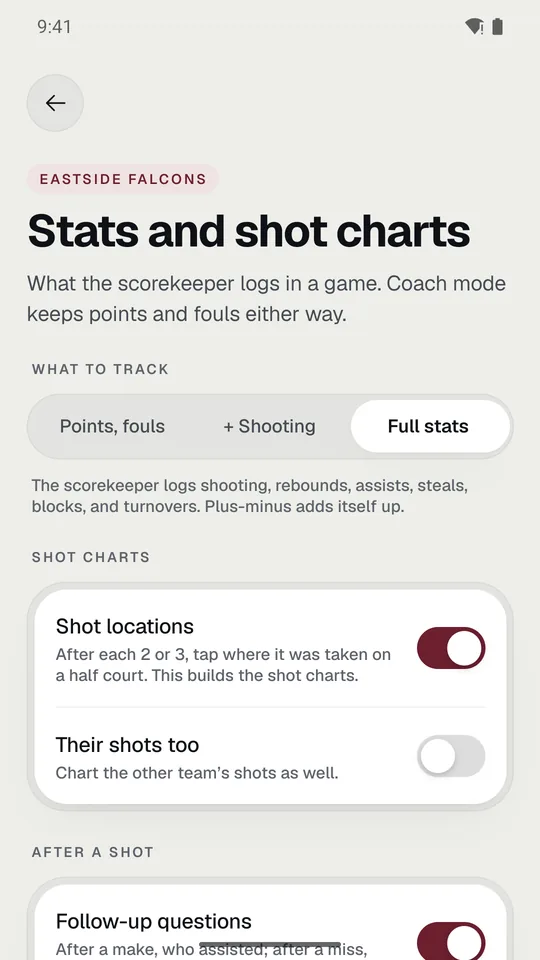
    • Full stats: shooting, rebounds, assists, steals, blocks, and turnovers. Plus-minus adds itself up.

This is what the scorekeeper logs. A game kept in coach mode tracks points and fouls either way. Stats are free.

Stats and shot charts, with Full stats picked.

Schedule

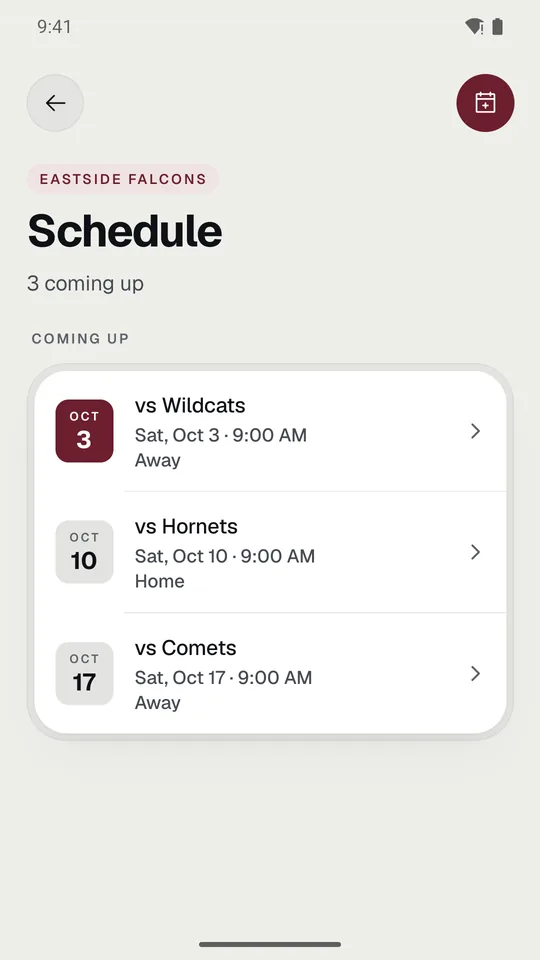
Add the season’s games once. The next one shows on Home, and starting it fills in the opponent for you.

Add a game to the schedule

  1. Go to Team › Schedule and tap the calendar icon at the top right (Add a game).
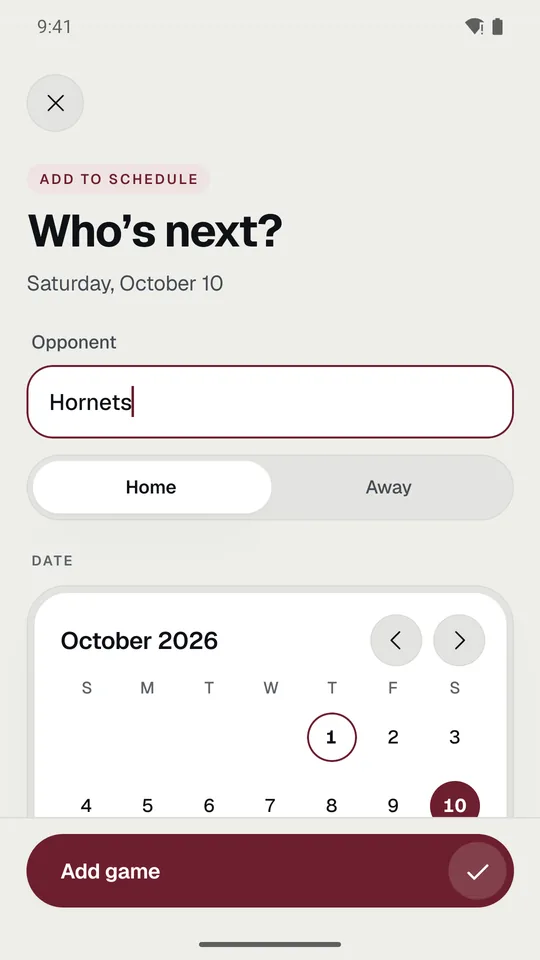
  2. Type the Opponent, like “Tigers”.
  3. Pick Home or Away.
  4. Pick the date on the calendar, then the Tip-off time.
  5. Add Where, like “Rec Center, court 2”, if you like.
  6. Tap Add game.
Tip

You can also add a game from the Game tab: under Up next, tap Add games.

Adding a game: the opponent, home or away, and the calendar.

Start a scheduled game

  • From Home: the main card shows your next game (or Today). Tap Start game.
  • From the schedule: tap the game, then Start this game.

The new game screen opens with the opponent and home or away filled in, and the game comes off the schedule. It uses your league rules as they are at tip-off.

Turn the schedule off

Go to Team › Settings and, under Features, turn off Schedule. The Schedule row, Up next, and the next game on Home go away, and you start each game on the spot. Games you’d scheduled are kept for when you turn it back on.

Game day

Start a game, keep score from the bench or the book, sub fairly, and fix mistakes as you go. Everything on game day is free.

Start a game

  1. Tap Start game on Home, or New game on the Game tab. To start a game from the schedule, see Start a scheduled game.
  2. Type the Opponent and pick Home or Away.
  3. Under Who’s keeping stats?, pick Coach or Scorekeeper. See Coach or scorekeeper.
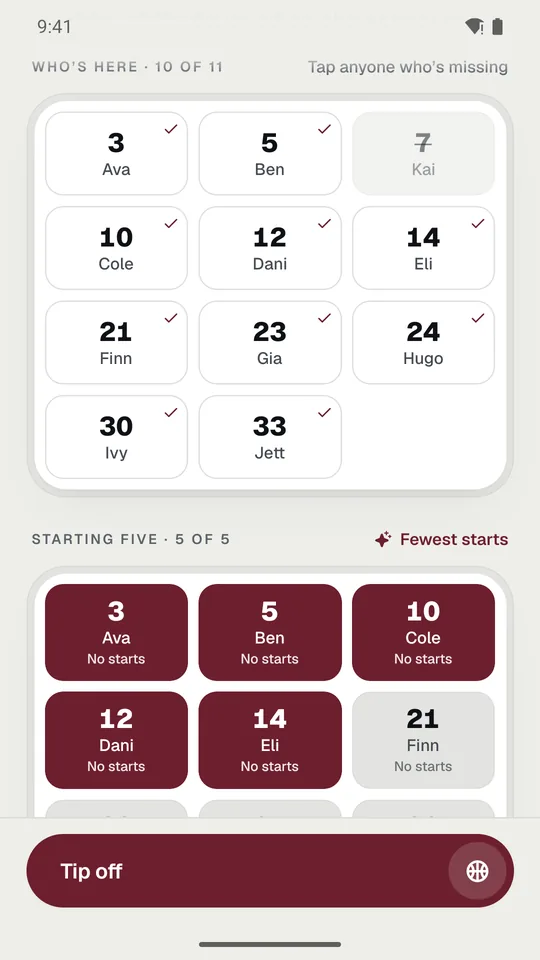
  4. Under Who’s here, tap anyone who’s missing.
  5. Under Starting five, tap your starters.
  6. Tap Tip off.

The game keeps a copy of your league rules from this moment, so changing them later never rewrites it. One game can be live per team at a time.

The new game screen: who’s here, with one player missing, and the starting five.

Check in who’s here and pick starters

On the new game screen:

  1. Who’s here lists every active player, all checked in. Tap a player who isn’t there; they’re struck through.
  2. Starting five lists the players who are here, each with how many games they’ve started. Tap your starters.
  3. Or tap Fewest starts to pick the players who’ve started the fewest games, so everyone gets turns.

The button at the bottom says how many more starters to pick, then becomes Tip off. With fewer players here than your league puts on the court, you start short. Who’s here also counts toward season attendance.

Coach or scorekeeper

Each game, pick who keeps it:

  • Coach: points and fouls, one-handed from the bench. The other team is points and fouls too.
  • Scorekeeper: everything your team tracks (shooting or full stats if they’re on), the other team’s jersey numbers on baskets and fouls, and a running play-by-play.

A team that tracks shooting starts on Scorekeeper. Shooting percentages and full stats only come from games kept by a scorekeeper. What the scorekeeper tracks is set in Team › Settings › Stats and shot charts.

Plan the rotation

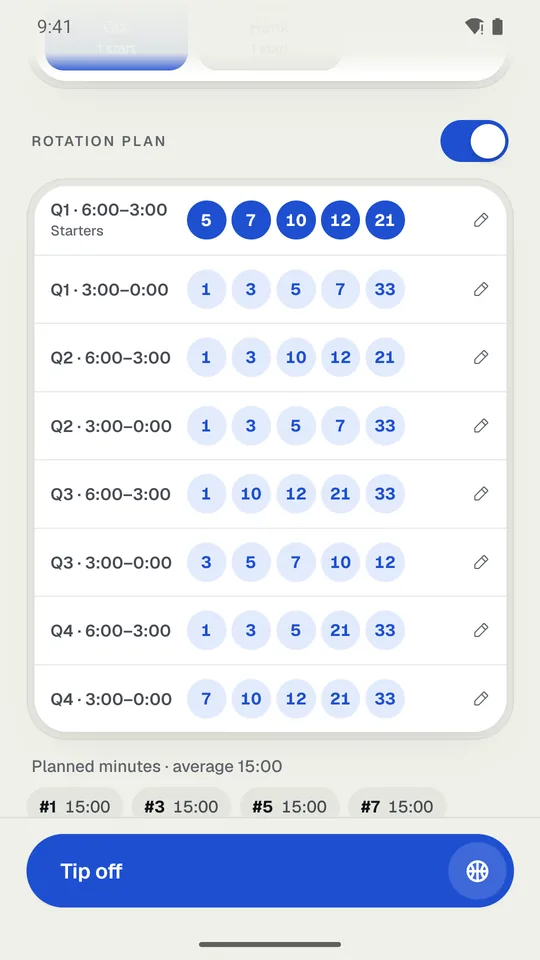
When your league subs in shifts or by period, the new game screen plans the whole game for you.

  1. Turn on Rotation plan. It’s on to start unless your league subs anytime.
  2. Pick your starters. Every shift fills in, fair by minutes.
  3. To set a shift yourself, tap it, check the players, and tap Set this shift.
  4. Planned minutes shows each player’s total. A player a full shift under the average is marked.
  5. Changed your mind? Re-plan it fair clears the shifts you set by hand.

During the game, Next five follows the plan at each sub time, skipping anyone who fouled out or left. The plan covers regulation, not overtime.

The rotation plan: every shift laid out, fair by planned minutes.

Run the clock

  • Start or stop: tap the clock (or the Start and Stop pill under it).
  • Match the gym clock: press and hold the clock, or use the Game menu › Set the clock. Use the buttons (−1:00, −10s, −1s, +1s, +10s, +1:00) and tap Set clock. Players’ minutes adjust to match.

Every period starts with the clock stopped: tap Start at tip-off. A timeout stops the clock. In stop-clock leagues (and a running clock’s final stop-clock minutes), a foul stops it too. At 0:00 the period ends by itself.

Note

In a league with no clock, the app counts time played for minutes, and you end each period from the Game menu.

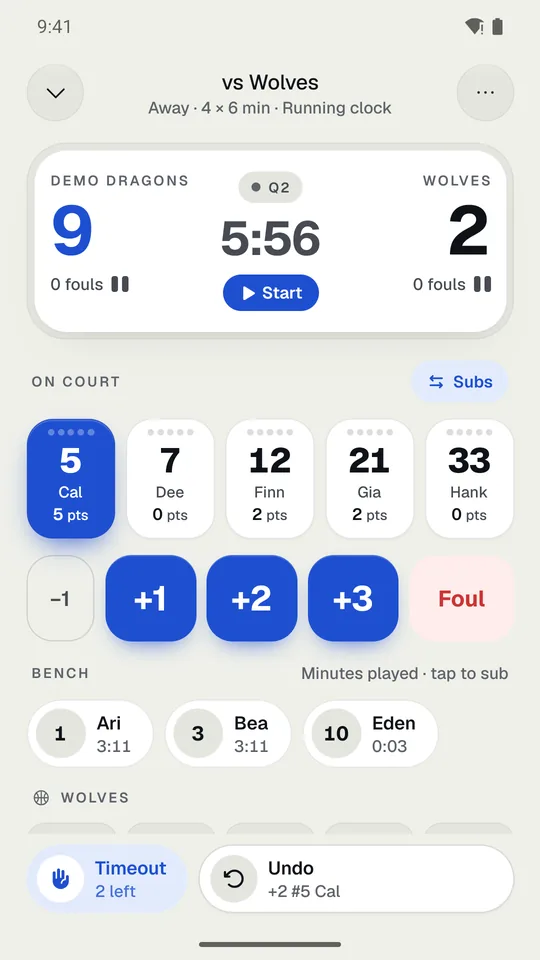
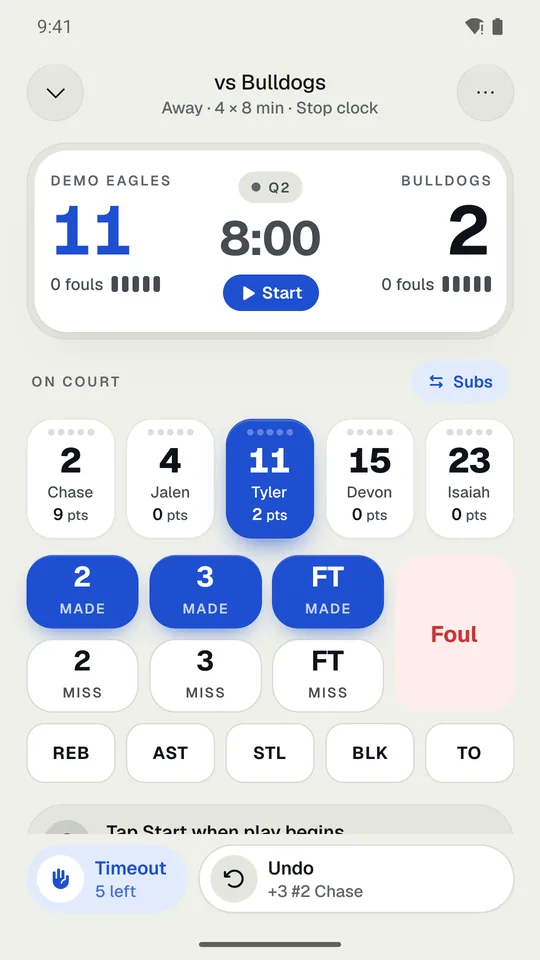
Read the scoreboard

  • Each side: the team name, the score, team fouls, and bars for timeouts left. Tall bars are full timeouts; short bars are 30-second ones.
  • The middle: the period (Q1, H1, OT), the clock, and Start or Stop. A dot pulses while the clock runs. Mercy shows next to the period once the mercy rule kicks in.
  • Bonus (or Bonus ++ for the double bonus) shows under the team shooting it.
  • Player tiles: the dots across the top are fouls, filled red as they’re called.
A live game in coach mode: the scoreboard, the players on the court, and the scoring buttons.

Score a basket

In coach mode:

  1. Tap the player’s tile. It fills with your team color.
  2. Tap +1, +2, or +3.

The player stays picked, so a second basket is one tap. Tap the tile again to unpick them. +1 shows when your league shoots free throws, and +3 when it counts threes.

Log a foul

  1. Tap the player’s tile.
  2. Tap Foul.

A dot fills on their tile, the team foul count goes up, and the bonus shows when it’s reached. At the foul limit, the app says the player fouled out and asks you to sub someone in.

Keep the book: shooting and full stats

When a scorekeeper keeps a team that tracks shooting, the pad has two rows:

  • 2 MADE, 3 MADE, FT MADE on top.
  • 2 MISS, 3 MISS, FT MISS below.
  • A tall Foul button on the right.
  • With full stats, a third row: REB, AST, STL, BLK, TO.
  1. Tap the player.
  2. Tap what happened.

There’s no −1 on this pad: use Undo or fix the entry. Plus-minus adds itself up from who was on the court.

The scorekeeper’s pad: Made and Missed rows, Foul, and the full stats row.

Answer the assist and rebound questions

With Follow-up questions on, a question shows under the pad after some shots:

  • After your team’s made 2 or 3, like Assist on #5 Cal’s 2?: tap the player who passed, or No assist.
  • After any miss, like Rebound on #5 Cal’s miss?: tap the player who got it, Team, or Theirs.

Offensive and defensive rebounds sort themselves out. To skip a question, tap × or carry on scoring.

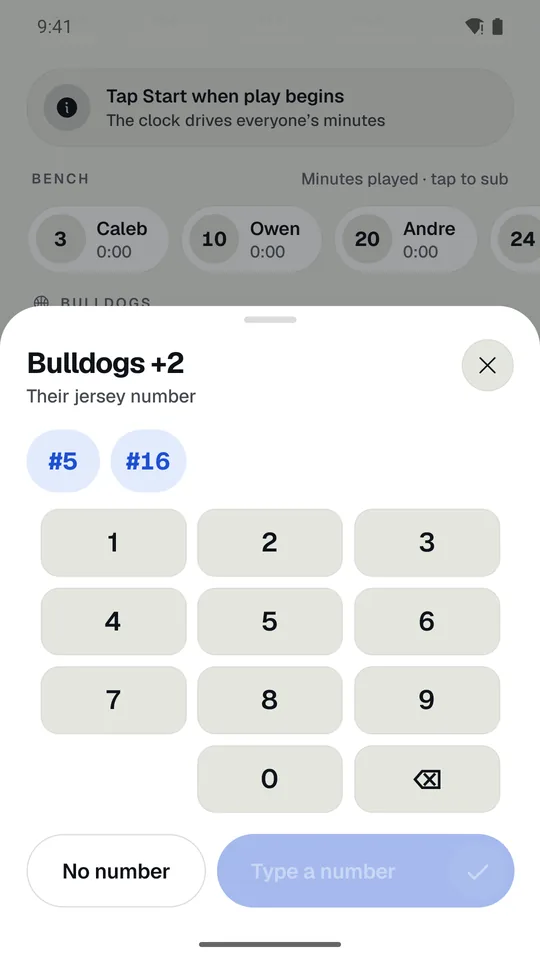
Enter the other team’s jersey numbers

When a scorekeeper logs anything for the other team, the jersey pad opens.

  1. Tap a recent number, or type it on the keypad.
  2. Tap Save #23 (with the number), or No number if you didn’t see it.

Players with two or more fouls show as chips, like #23 · 2 fouls, so you can see foul trouble. The box score lists the other team by number. Closing the pad logs nothing.

The jersey pad: recent numbers, a keypad, and No number.

Call a timeout

  1. Tap Timeout at the bottom left for your team, or Timeout on the other team’s row.
  2. If your league has 30-second timeouts, pick 60 seconds or 30 seconds.

The clock stops and a countdown appears under the team that called it. At 0:15 it turns amber and the phone buzzes. Undo takes back a timeout and its clock stop.

Make a substitution

One player for another

  1. Tap a player on the Bench. Each one shows their minutes.
  2. Tap the player on the court they replace.

Several at once

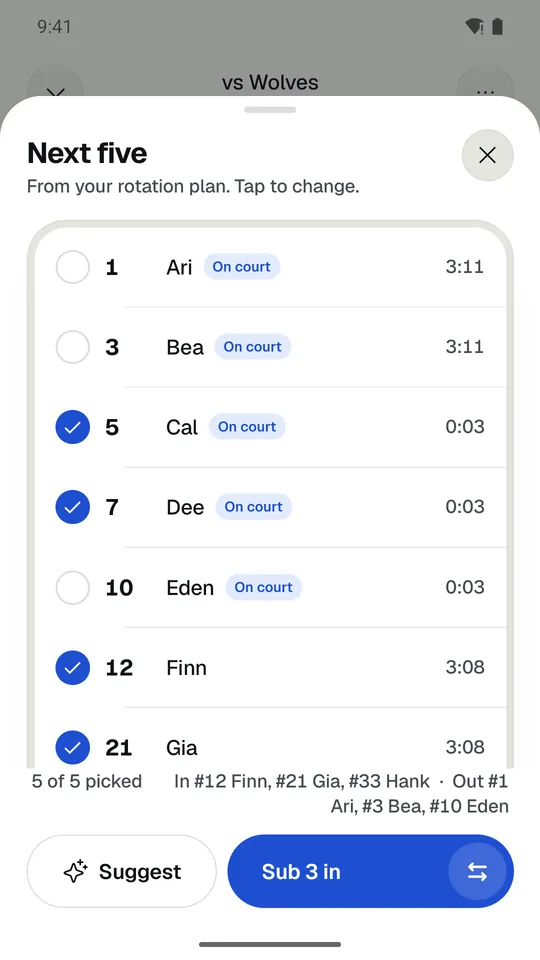
  1. Tap Subs next to On court (or Next five in a sub alert, or Game menu › Change lineup).
  2. The sheet suggests the next group: from your rotation plan, or fewest minutes first. Tap players to change it, or Suggest to pick by fewest minutes now.
  3. Tap Sub 2 in (with the number), or Keep lineup.

Players who stay keep their spot on screen. With too few players left, the sheet says you play short.

The Next five sheet: the next group from the rotation plan, and who goes in and out.

Respond to alerts

One alert shows at a time, the most important first:

AlertWhat to do
End of Q1Tap Next five to sub, then Start Q2.
#5 fouled outTap Sub to bring someone in.
Sub timeThe shift is over. Tap Next five, or Later.
Shift change in 0:25A heads-up 30 seconds before. Preview shows the next group.
#4 is 2:30 behind on minutesTap Sub in.
Tap Start at tip-offA reminder that the clock isn’t running yet.

The phone buzzes at the heads-up, at sub time, and at the end of a period.

Undo the last entry

Tap Undo at the bottom right. It names what it will undo, like +2 #5 Cal. Tap it again to undo the entry before that.

Undo covers baskets, misses, stats, fouls, timeouts, subs, arrivals, and players out. It doesn’t undo clock starts and stops or the end of a period.

Remove or move an entry

  1. Press and hold a player’s tile, a bench player, or a team’s score. Their entries for this game open.
  2. To remove one, tap the trash icon, then Remove.
  3. To give it to the right player, tap ⇆, then pick the player. It keeps its place in the game, and a shot’s location goes with it.

The full play-by-play has the same buttons: tap All next to it (scorekeeper), or Fix an entry on a tablet.

Tip

A player marked fouled out by mistake? Press and hold their bench spot and remove the foul.

End a period and go to overtime

  • A period ends by itself at 0:00. If the gym’s buzzer beat the app, use the Game menu › End Q2 now.
  • In the break, sub if you like, then tap Start Q2 on the alert. Remember to start the clock at tip-off.
  • Ended a period by mistake? The Game menu › Back to Q1 reopens it.
  • Tied after regulation: tap Overtime. Its length comes from your league rules, and each overtime adds a timeout.

Leave and come back to a live game

  • Leave: tap the arrow at the top left (Minimize game). Android’s back button asks first: press it twice to leave. The game keeps going.
  • Come back: tap Resume game on Home or the Game tab.

The clock keeps running while you’re away. Every tap is saved as it happens, so if the phone restarts or the app closes, the game picks up where it was. The screen stays on during a game.

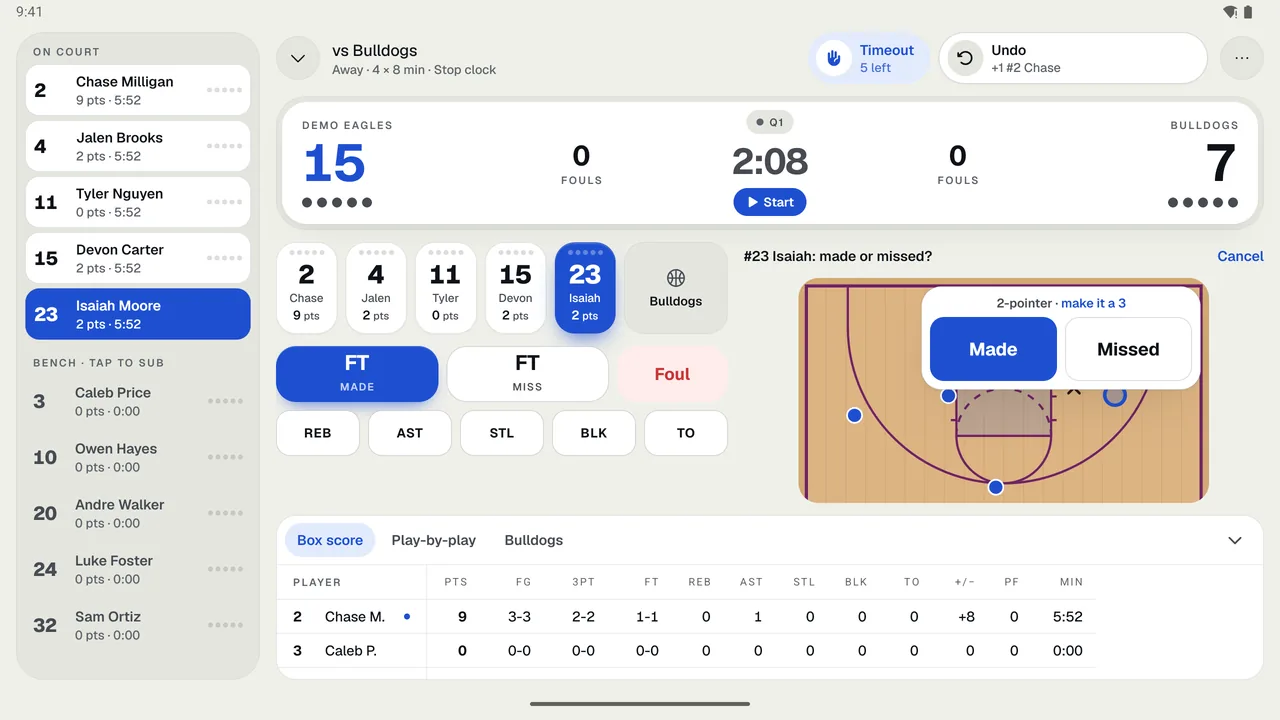
Keep the book on a tablet

On a tablet, a game always turns sideways:

  • Left: the players on the court, then the bench, with points, minutes, foul dots, and a Behind flag. Tap a bench player, then who they replace, to sub.
  • Top: the scoreboard, with Timeout, Undo, the current alert, and the Game menu.
  • Middle: the five and a tile for the other team, then the pad.
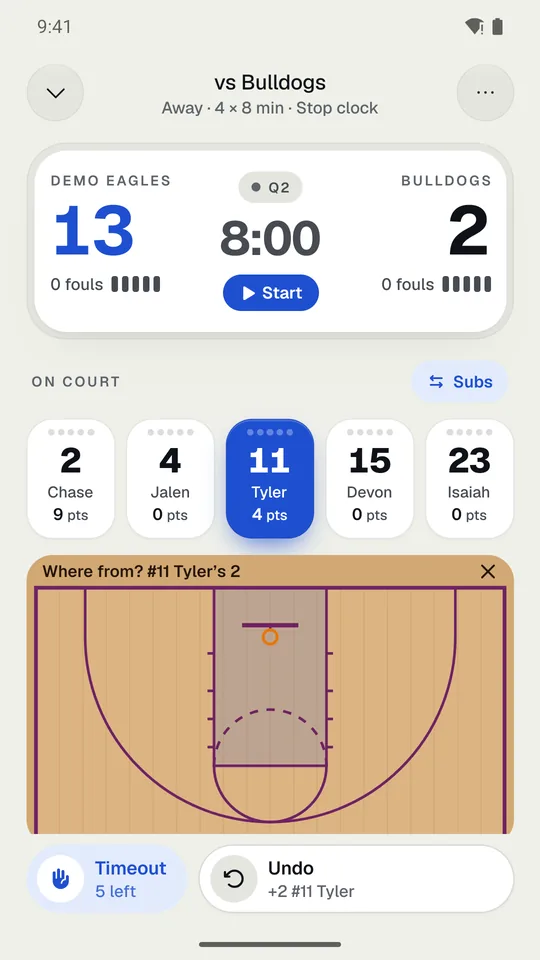
  • Right: the court. With shot locations on, pick a player, tap where the shot was, then tap Made or Missed. It counts as a 2 or a 3 by the line; tap make it a 3 (or a 2) to change it.
  • Bottom: tabs for the live Box score, the Play-by-play (with Fix an entry), and the other team by number. Tap to fold them down.
A tablet game: the roster down the left, the scoreboard, the pad, and the court.

After the game

The box score writes itself. Share it, fix it, and watch the season add up.

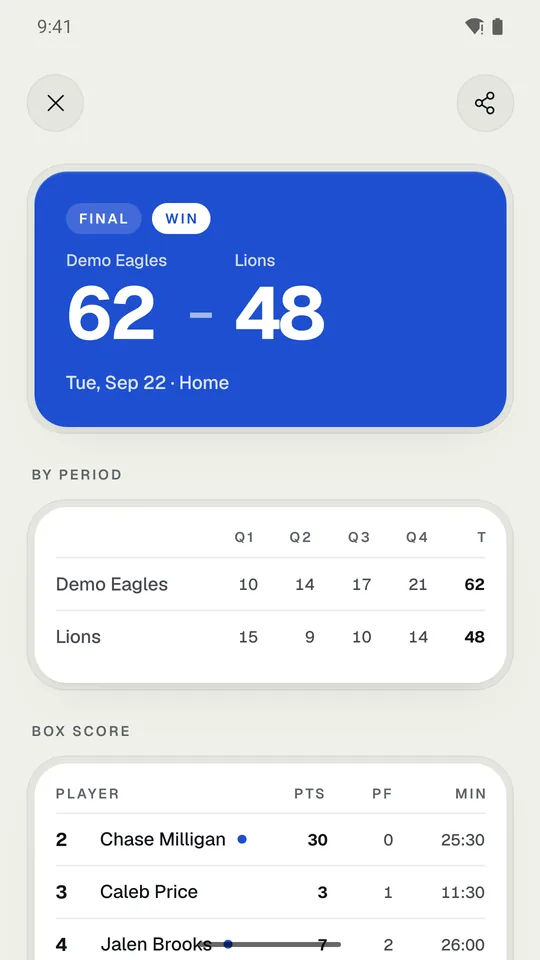
Read the box score

From top to bottom:

  • The final: both scores, win or loss, the date, and home or away.
  • By period: each team’s points in each quarter or half.
  • Box score: every player’s PTS, PF (fouls), and MIN. A ● marks the starters.
  • Stats: rebounds, assists, steals, blocks, turnovers, and plus-minus, when the game kept full stats.
  • Shooting: field goals, threes, and free throws as made and attempted, with percentages, when the game kept shooting.
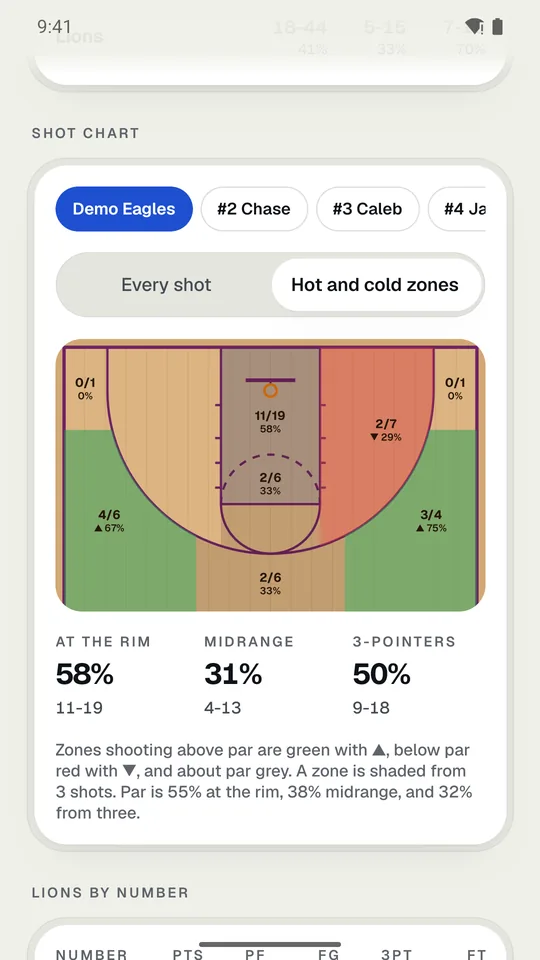
  • Shot chart: when shots were marked on the court.
  • The other team by number: when a scorekeeper entered their jersey numbers.
  • Playing time: when your league has a playing-time goal.

A game kept in coach mode shows points, fouls, and minutes. See Stat abbreviations for what each column means.

A box score: the final, by quarter, and every player’s points, fouls, and minutes.

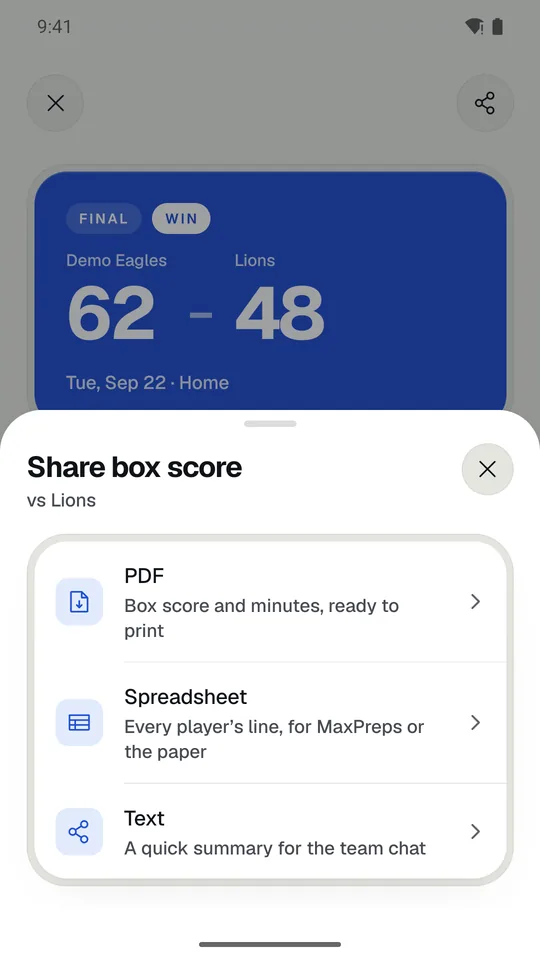
Share a box score

  1. Open the game and tap the share icon at the top right (Share box score).
  2. Pick one:
    • PDF: the box score and minutes, ready to print, in your team colors. With shooting, it adds the shot charts.
    • Spreadsheet: a CSV with every player’s line, for MaxPreps or the paper.
    • Text: a quick summary for the team chat.
  3. Send it or save it from your phone’s share sheet.

All of these are free.

The Share box score sheet: PDF, Spreadsheet, or Text.

Delete a game

  1. Open the game and scroll to the bottom.
  2. Tap Delete game, then Tap again to delete this game.

The game leaves the game log and season stats, and waits in Team › Settings › Recently deleted for 30 days.

Sort and read the season table

  • Tap a column heading to sort by it, highest first. Player sorts by jersey.
  • On a phone, the names stay put while the numbers scroll sideways.
  • Columns for shooting (FG%, 3P%, FT%) show once a game has kept shooting, and full stats once a game has kept them.
  • The Team row at the bottom has the totals.

Percentages only count games that kept shooting, so a game kept in coach mode doesn’t pull anyone’s numbers down. GP counts the games a player actually played in.

Use player cards and fair share

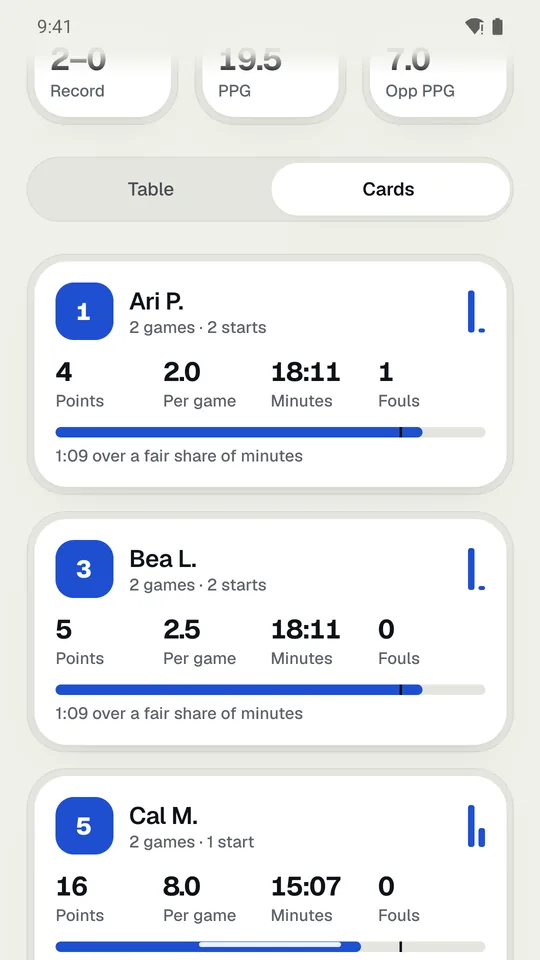
Tap Cards in season stats. Each card shows a player’s games, starts, points, minutes, and fouls, a small chart of their points game by game, and their shooting and stats when they were kept.

With a playing-time goal on, each card has a fair share bar. A player’s fair share is the team’s court time in each game they were at, split evenly among everyone who was there. The card says “Right at a fair share of minutes”, or how far over or under.

Season player cards with each player’s fair share of minutes.

See season shot charts Pro

  1. Go to Team › Season stats and scroll to Shot chart.
  2. Pick the team or one player.
  3. Pick Hot and cold zones or Every shot.

Every marked shot from every game goes on one court, by player. With Pro, each player card and the season PDFs get the charts too.

Pro

Without Pro, you’ll see how many shots have been marked and a See Pro button. Each game’s own chart stays free in its box score.

Export season stats

  1. Go to Team › Season stats and sort the table the way you want it.
  2. Tap the share icon at the top right (Export season stats).
  3. On Table, pick PDF or Spreadsheet (CSV). On Cards, the PDF is a page of player cards.

Exports follow the order on screen. They’re free; with Pro, the season PDFs include the shot charts.

How shot zones work

  • At the rim is any 2 within 6 feet of the basket, Midrange is any other 2, and 3-pointers are shots logged as 3s.
  • Hot and cold zones splits the court into nine: at the rim; left, middle, and right midrange; and the corner, wing, and top-of-the-key 3s on each side.
  • A zone is shaded once it has 3 shots. It’s hot (green, ▲) at 8 points or more above par, cold (red, ▼) at 8 or more below, and grey near par.
  • Par is 55% at the rim, 38% from midrange, and 32% from three.

Stat abbreviations

LabelMeans
PTSPoints
PFPersonal fouls
MINMinutes played
GPGames played (games the player was in, not only at)
PPGPoints per game
Opp PPGPoints per game the other teams scored
MPGMinutes per game
FGField goals made and attempted (2s and 3s)
3PT3-pointers made and attempted
FTFree throws made and attempted
FG%, 3P%, FT%Shooting percentages, from games that kept shooting
REBRebounds (offensive and defensive)
ASTAssists
STLSteals
BLKBlocks
TOTurnovers
+/−Plus-minus: the score’s swing while the player was on the court
●Started the game
TThe game’s total, in By period

Playbook

Draw plays on a real court, watch them run step by step, and show them to the team. Everything here is free except the starter playbook.

Find your way around the Plays tab

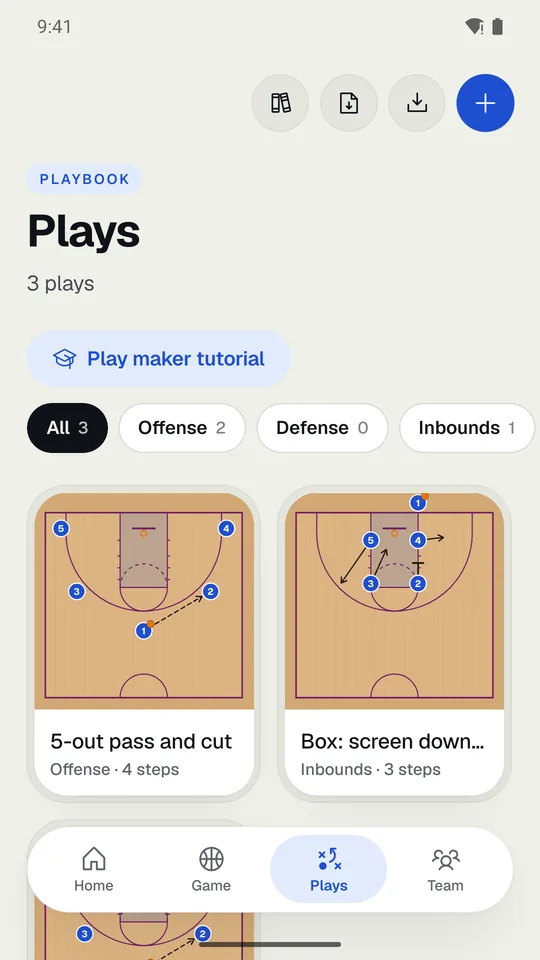
The Plays tab is your playbook. The buttons at the top, from left to right:

  • Starter playbook (the books icon): ready-made plays to copy. Part of Pro.
  • Export playbook as PDF: shows once you have a play.
  • Import a shared play: adds a play file another coach sent you.
  • New play (the + button).

Under them, the folder chips (All, Offense, Defense, Inbounds, Press break) filter the list. Each card shows the play’s starting spots and its first step. The play you edited last comes first. Tap a card to open it.

Tip

The folder you pick also decides what goes in the playbook PDF.

The Plays tab with three plays and the folder chips.

Read a play diagram

Every play uses the same marks, on screen and in the PDF. The basket is at the top, and left and right are as the diagram reads.

MarkWhat it means
Filled circle with a numberAn offensive player. The number is a position (1–5) or a jersey number, never a name.
X with a small numberA defender, when defense is on.
Small orange ballWho has the ball. After a shot it sits at the basket.
Solid line with an arrowA cut.
Zigzag line with an arrowA dribble. Only the player with the ball dribbles.
Dashed line with an arrowA pass. It ends where the catcher finishes the step.
Line ending in a flat barA screen.
Dotted curve to the basketA shot.

Take the play maker tutorial

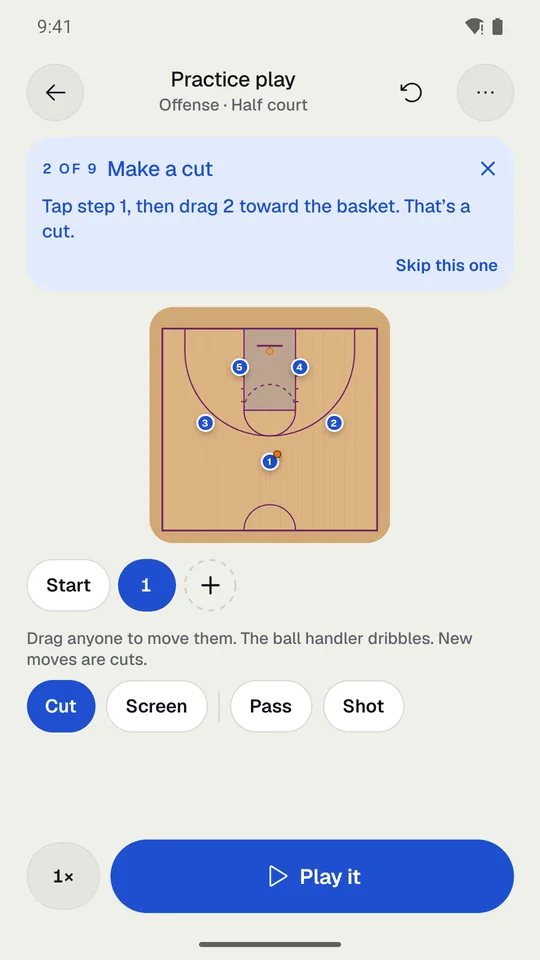
The tutorial walks you through every tool on a practice play in about a minute. Nothing in it is saved.

  1. On the Plays tab, tap Play maker tutorial. In an empty playbook, it’s Take the 1-minute tutorial.
  2. Tap Start, then do what each card asks: line them up, make a cut, curve it, pass, add a step, dribble, set a screen, take the shot, and watch it run.
  3. Each card moves on by itself once the play shows you’ve done it. Doing things out of order skips ahead. Skip this one moves on without doing it.
  4. On the last card, tap Build my own to start a real play, or Done.
Note

You can open the tutorial again from any play: tap ⋯ (Play options), then Play maker tutorial.

The builder with the tutorial card “Make a cut” above the court.

Make a new play

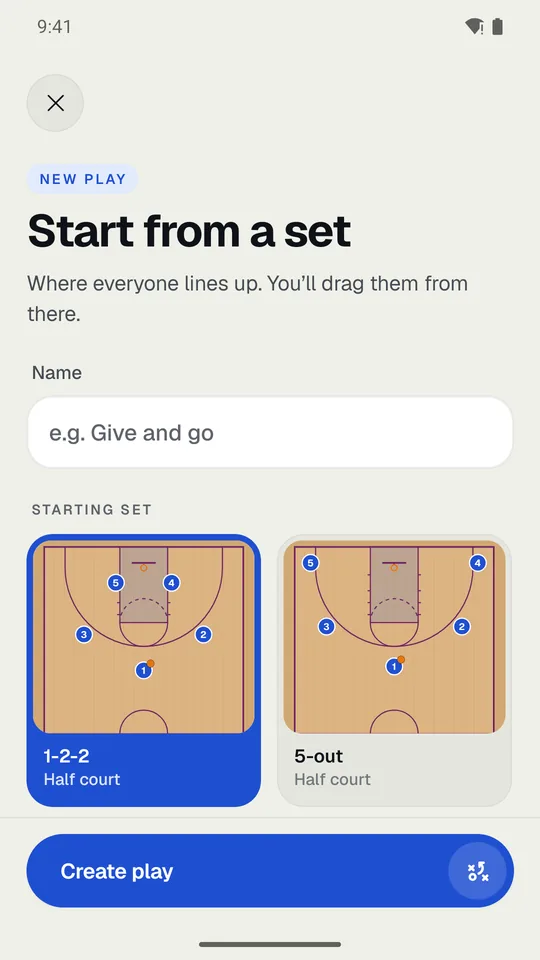
  1. On the Plays tab, tap + (New play).
  2. Type a Name, like “Give and go”. You can leave it blank and name it later.
  3. Under Starting set, pick where everyone lines up: 1-2-2, 5-out, 1-3-1, Box inbounds, Stack inbounds (all half court), or Press break (full court).
  4. Tap Create play. The play opens on step 1, ready for you to drag players.

The starting set also picks the folder: the three offensive sets go in Offense, Box and Stack go in Inbounds, and Press break gets its own folder. In the inbounds sets and Press break, player 1 starts out of bounds to inbound the ball. Defense starts off, and the circles show positions 1–5. You can change all of it later under ⋯.

The New play screen with the 1-2-2 starting set picked.

Set the starting spots

  1. Open the play and tap Start in the step strip under the court.
  2. Drag any player to where they line up.
  3. To give someone else the ball, tap that player, then tap Give #3 the ball (with their number).
  4. Tap Done when you’re finished with a player.

If defense is on, drag the X’s at Start to place them. They don’t follow later changes to the offense.

Move players: cuts and screens

  1. Tap a step number in the step strip, like 1.
  2. Pick Cut or Screen in the tool row. That sets the type of the next move you draw.
  3. Drag a player to where they go in this step. A line shows the path. Several players can move in the same step, the way real plays work.
  4. To change one move, tap the player who makes it. Then tap Cut or Screen to switch it, Straighten to take out a curve, or Remove move.

Dragging a player back to where they started the step also removes their move. The player with the ball always dribbles: see Dribble, and pass on the move.

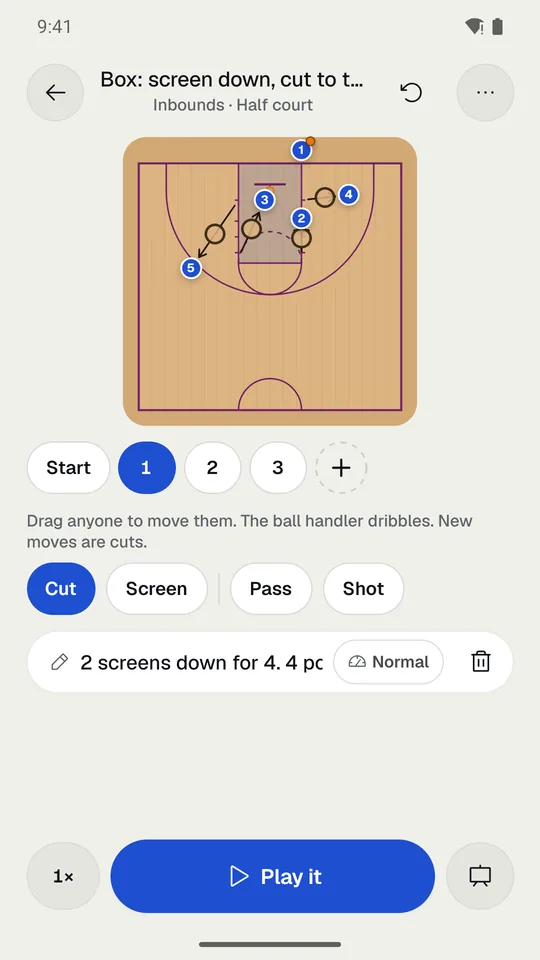
A play’s first step: a screen with a flat bar and three cuts.

Curve a path

Every move in the step has a dot halfway along its line. A hollow dot means the path is straight; a filled one means it’s curved.

  1. Drag the dot to bend the path.
  2. To straighten it, drag the dot back to the middle, or tap the player and tap Straighten.

Draw a pass or a shot

A pass

  1. In a step, tap Pass.
  2. Tap the teammate who catches it.

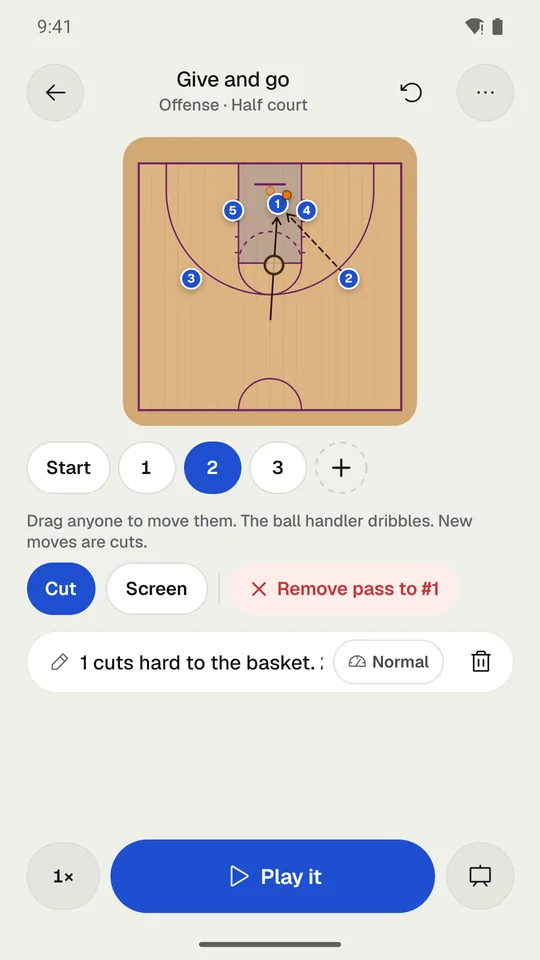
The pass line runs from the passer to where the catcher ends the step, so a pass to a cutter meets them on the move. When it plays, the ball leaves halfway through the step.

A shot

  1. In a step, tap Shot. Whoever has the ball shoots.

Each step can have one pass or one shot. To take it back, tap Remove pass to #2 or Remove shot. After a shot, nobody has the ball, so later steps can’t pass or shoot.

A step with a cut and a dashed pass line to the cutter.

Add, delete, and time steps

  • Add a step: tap the dashed + at the end of the step strip. It goes after the step you’re on.
  • Delete a step: tap the trash icon beside the step’s note. Undo brings it back.
  • Add a note: type in the note field under the court, like “Wait for the screen.” Notes show in large type in present mode and in the PDF.
  • Change a step’s speed: tap the chip at the end of the note row. It goes Normal, Slow (half speed), then Fast (double speed). The speed goes with the play to present mode and to shared files.

Undo a change

Tap the curved arrow (Undo last change) at the top of the builder. It goes back up to 60 changes while you’re on the play. Leaving the play clears it.

Note

Undo covers moves, passes, shots, steps, defense, and mirroring. It doesn’t undo step notes, step speed, or changes to the name, folder, or numbers.

Play it back

  1. Tap Play it. The play runs from the start.
  2. Tap Pause to stop. Drag the slider to move through the play by hand; the ticks are the steps.
  3. Tap the speed chip to switch between 0.5×, 1×, and 2×.
  4. Tap any step number to go back to editing.

If your phone’s Reduce motion setting is on, playback starts at 0.5×.

Show a play to the team

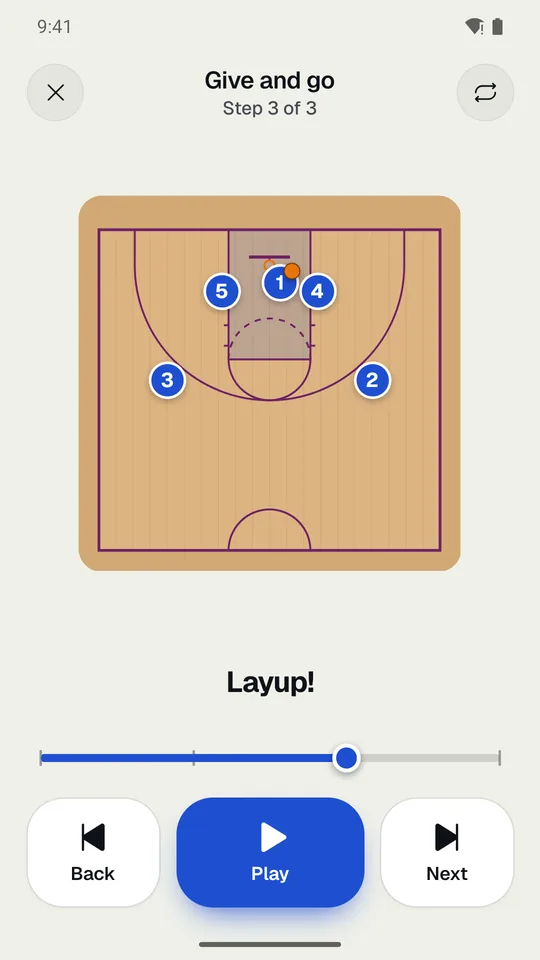
Present mode shows the play big, with nothing to edit, for a timeout huddle or a tablet at practice.

  1. Open the play and tap the present icon (Present to the team) at the bottom right.
  2. Tap Play to run it, or Next and Back to go one step at a time. When it’s done, Replay runs it again.
  3. Tap the loop button at the top right to keep it repeating.
  4. Tap × to close.

Present mode runs at 0.75× speed, shows each step’s note in large type, and keeps the screen on.

Present mode: a big court, the step note, and Back, Play, and Next.

Rename, move, mirror, or duplicate a play

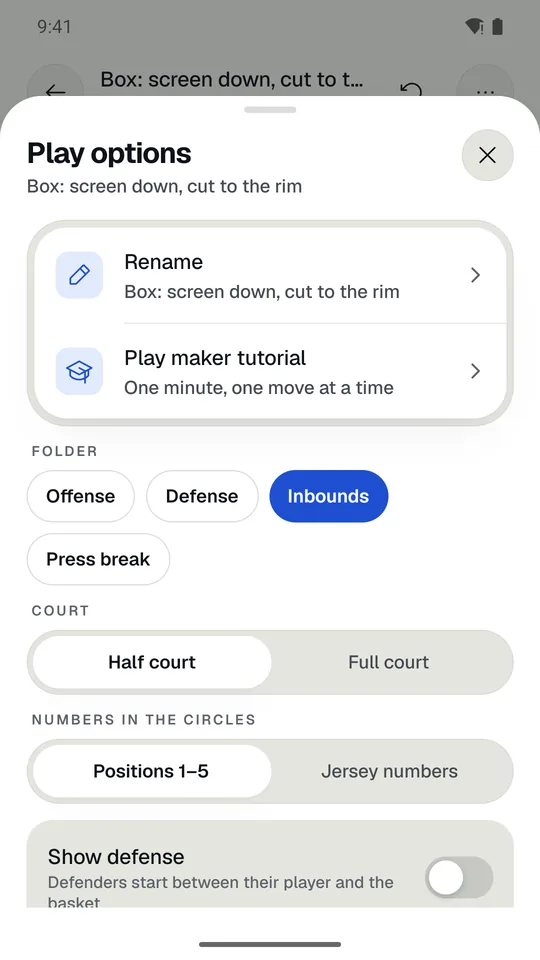
Open the play and tap ⋯ (Play options) at the top right.

  • Rename: type a new name and tap Save. You can also tap the play’s name at the top.
  • Folder: Offense, Defense, Inbounds, or Press break.
  • Court: Half court or Full court. Going back to half court pulls everyone onto the half court.
  • Mirror: runs the play to the other side.
  • Duplicate: makes a copy to change into a variation.
The Play options sheet.

Turn on defense

  1. Open the play and tap ⋯, then turn on Show defense. Or tap Add defense at Start.
  2. Defenders start between their player and the basket. Drag them at Start to place them.
  3. In any step, drag a defender to move them. Defenders can cut and screen, but never catch a pass.

Turning defense off removes the defenders’ moves. Undo brings them back.

Import a play someone sent you

  1. Save the play file to your phone, or keep it where you can find it, like your downloads or Drive.
  2. On the Plays tab, tap Import a shared play.
  3. Pick the file. The play is added to your playbook and opens.

A file from a newer version of Sixth Man still comes in; anything this version doesn’t know is left out.

Add plays from the starter playbook Pro

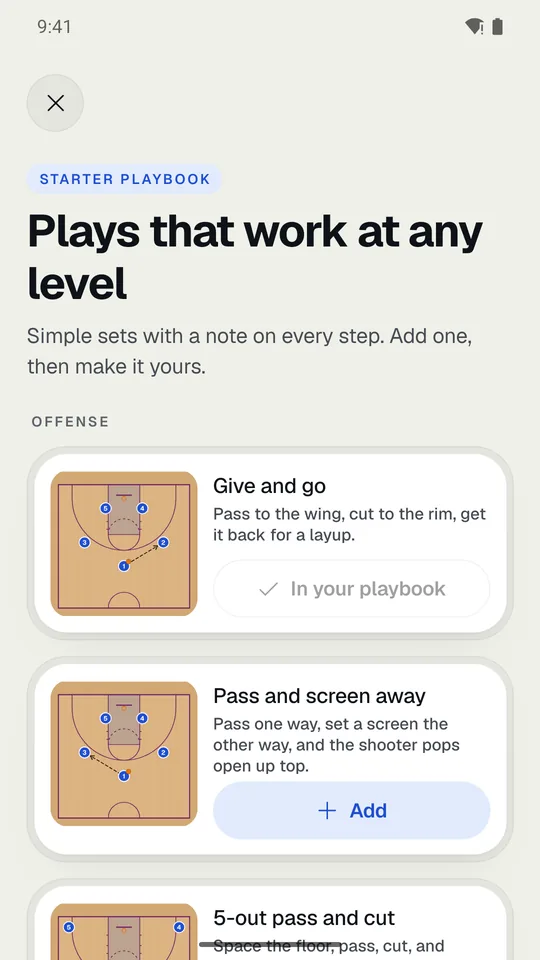
Seven simple, proven sets, each with a note on every step. Add one, then make it yours.

  1. On the Plays tab, tap the books icon (Starter playbook).
  2. Tap Add on a play. A copy goes in your playbook and opens.
PlayWhat it does
Give and goPass to the wing, cut to the rim, get it back for a layup.
Pass and screen awayPass one way, screen the other way, and the shooter pops open up top.
5-out pass and cutSpace the floor, pass, cut, and everyone fills the open spot.
Defense: jump to the ballOn every pass, defenders move: one closes out, everyone else helps.
Box: screen down, cut to the rimUnder-the-basket inbounds: an elbow screens down, the other cuts.
Stack: everybody breaksLine up in a stack, then all break on the slap.
Press break: sidelineMeet the pass, then attack up the sideline.
Pro

Without Pro, the books icon opens Pro on this feature. Once you buy, you land back here.

The starter playbook, with an Add button on each play.

Change the court style

  1. Go to Team › Settings › Name and colors.
  2. Under Court style, pick Wood, Team color, or Whiteboard.
  3. Tap Save.

The court style shows in the play builder, present mode, and the playbook PDF. In dark mode, the whiteboard becomes a chalkboard.

Delete a play

  1. Open the play and tap ⋯.
  2. Tap Delete play, then Tap again to delete.

The play goes to Team › Settings › Recently deleted for 30 days, where you can put it back.

Edit plays with a screen reader

With TalkBack on, the court reads each step aloud, like “Step 2: 1 cuts to the right block. 2 passes to 1.”

  1. Select a player. Up, Down, Left, and Right buttons appear; each moves them 3 feet.
  2. Or use TalkBack’s actions menu on a player: Move up, Move down, Move left, Move right.
  3. The playback slider moves one step at a time.

Practices and attendance

Plan practices by the minute, run them on a drill timer, and see who came all season. Part of Pro; anyone can look through the ready-made practices.

Look through the ready-made practices

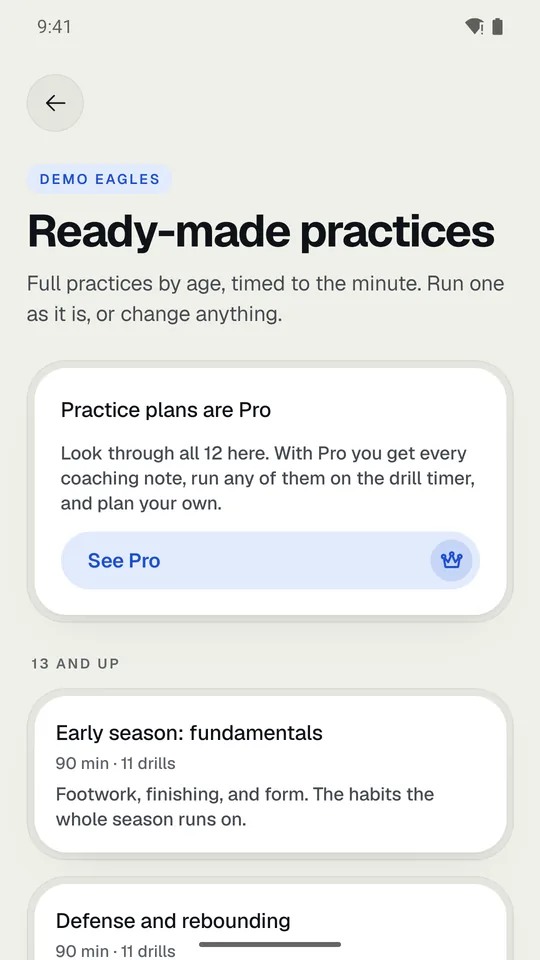
Twelve full practices, four for each age group, timed to the minute with a coaching note for every drill.

  1. Go to Team › Practices. Without Pro, it opens the ready-made practices; with Pro, tap Ready-made practices.
  2. Tap a practice to see every drill and its minutes.
AgesPracticesLength
6 to 9First practice · Dribbling day · Layups and shooting · Game-week practice60 min
10 to 12Ball handling and finishing · Man-to-man defense · Passing and moving · Game-week practice60 min
13 and upEarly season: fundamentals · Defense and rebounding · Transition day · Game-week practice90 min

Youth teams see the younger ages first; other levels see 13 and up first.

Pro

Without Pro, you can look through all twelve, with the coaching notes for the first drill of each. Pro opens every note and lets you use them.

Ready-made practices, with the card a coach without Pro sees.

Plan a practice Pro

  1. Go to Team › Practices and tap New practice. It starts tomorrow at 6:00 PM with a 49-minute plan you can change.
  2. Under When and where, tap the date to change it, and type Where, like “Elementary gym”.
  3. Change the drills: see Add, change, and reorder drills.
  4. Add Notes for you and your co-coach, like “Work on boxing out.”

Everything saves as you go. Coming up and Past on the Practices screen list them all.

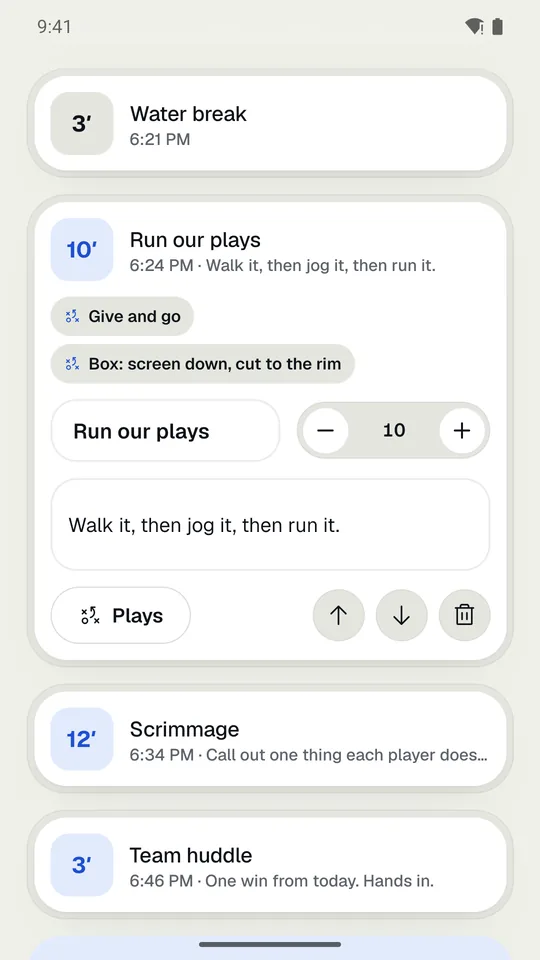
A practice plan with one drill open: its minutes, coaching points, and linked plays.

Add, change, and reorder drills Pro

  • Add a drill: tap Add a drill and pick one (Warm-up, Ball handling, Layup lines, Passing, Shooting form, Defense, Run our plays, Scrimmage, Water break, Team huddle), or Your own drill.
  • Change a drill: tap it to open it. Change the Drill name, the Minutes, and the Coaching points.
  • Reorder: open a drill and tap Move up or Move down.
  • Remove: open a drill and tap the trash icon.

The plan’s total length and each drill’s start time update as you go.

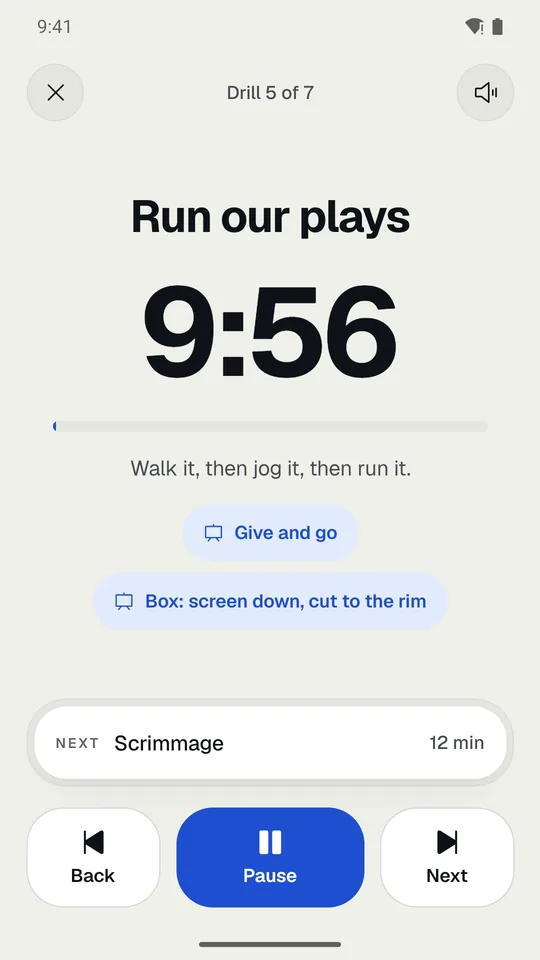
Run a practice with the timer Pro

  1. Open the practice and tap Run it at the top right.
  2. Tap Start. The drill counts down, with its coaching points below.
  3. When a drill reaches 0:00, the phone buzzes, a horn sounds, and the next drill starts by itself.
  4. Back and Next move between drills; Pause stops the clock.
  5. Tap × to close run mode.

The horn plays even with the phone on silent. Tap the speaker button at the top right to turn it off. The screen stays on while run mode is open.

Run mode: the drill, a big countdown, the coaching points, and a linked play.

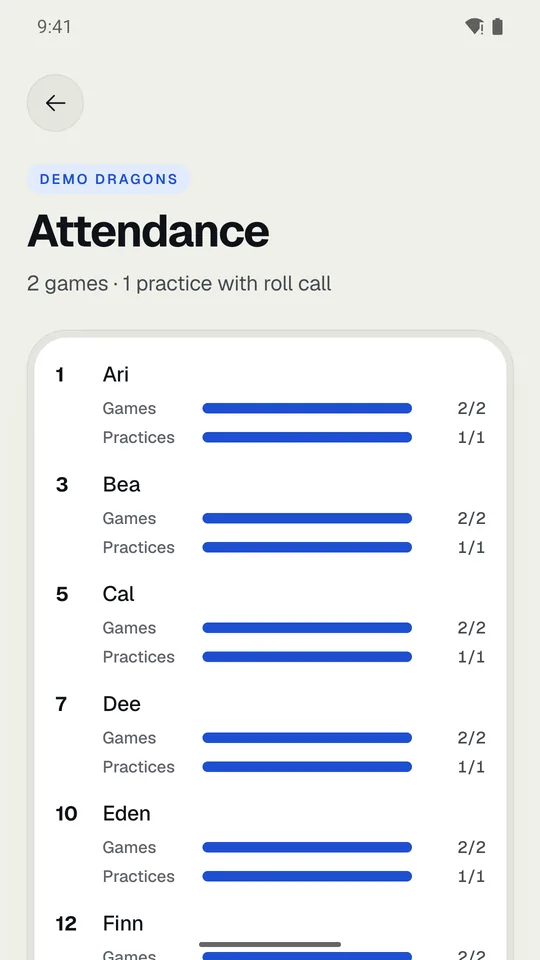
Take attendance at practice Pro

  1. Open the practice and find Attendance.
  2. Tap Take attendance. Everyone active is checked in.
  3. Tap anyone who isn’t there; their name is struck through.

It counts toward season attendance. Clear attendance takes the roll call off.

Copy a practice to next week Pro

Open the practice and tap Duplicate practice. A copy goes on the same day and time next week, with the same drills, plays, place, and notes. Attendance starts fresh.

Staff

Staff, coming to Pro, puts two more coaches on your team, seeing every change as it happens. Until then, share plays and backups as files: see Share a play with another coach and Send your team to a co-coach.

Sixth Man Pro

Game day, stats, the play builder, and exports are free for good. Pro adds the extras, as a yearly season pass or a one-time lifetime purchase.

What’s free and what’s Pro

Free, for goodPro
1 teamUp to 3 teams, and more with team spots
Game day: score, clock, fouls, timeouts, subs, playing time, rotation plansStarter playbook: seven simple, proven sets
Shooting, full stats, and each game’s shot chartSeason shot charts, by player, with hot and cold zones
The play builder, present mode, and sharing playsPractice plans: 12 ready-made practices and a drill timer
Schedule, game log, box scores, and season statsAttendance for games and practices
PDF and spreadsheet exports, and backupsYour own team logo
Parent contacts and a monogram badge

There are no ads, in either version.

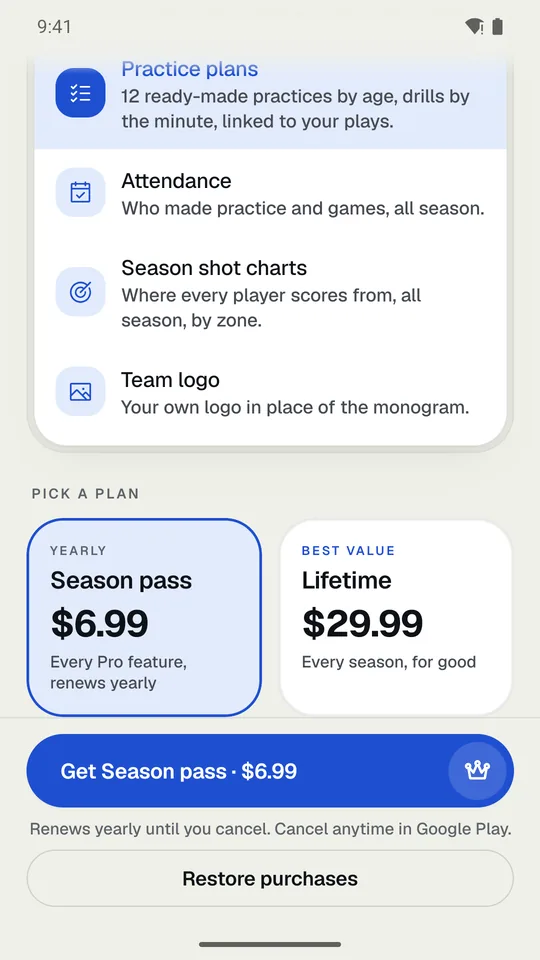
Buy Pro

  1. Go to Team › Settings › See what Pro adds, or tap any Pro feature (marked with a crown).
  2. Under Pick a plan, choose:
    • Season pass: $6.99 a year. Renews yearly until you cancel.
    • Lifetime: $29.99, once. Nothing renews.
  3. Tap Get Season pass or Get Lifetime, and finish in Google Play.

If you opened Pro from a feature, you land back on it, unlocked. Prices show in your own currency once Google Play loads them. A payment that’s pending, like cash at a store, turns Pro on by itself once Google Play confirms it.

Pro is for the teams you own, and it works offline.

The Pro screen: what Pro adds, and the season pass and lifetime plans.

Add more teams with team spots

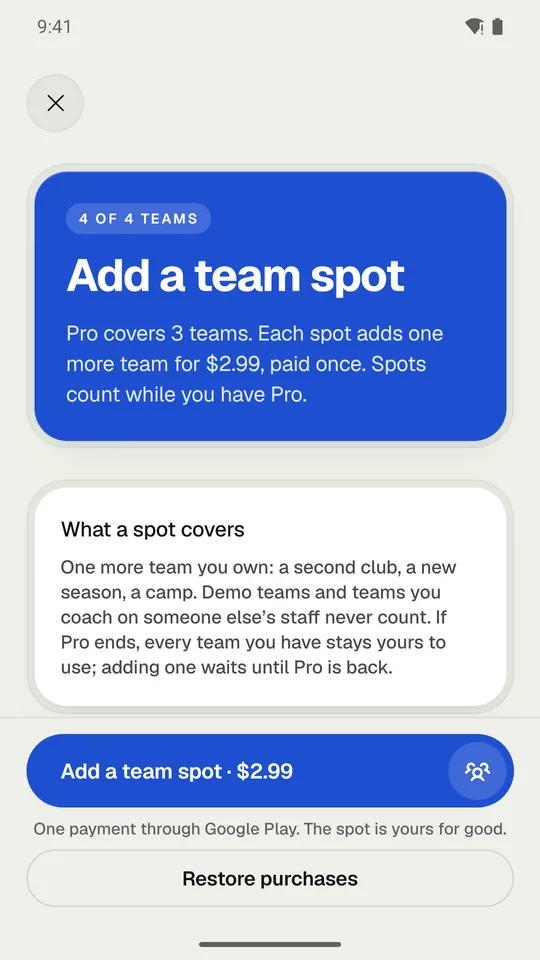
Pro covers 3 teams. Each team spot adds one more for $2.99, paid once, up to 8 teams in all.

  1. Tap the team name at the top of Home, then Add a team. When Pro’s teams are used, it says Team spot · $2.99.
  2. Tap Add a team spot · $2.99 and finish in Google Play.
  3. Setup opens for the new team.

Spots are yours for good, but they count only while you have Pro. Demo teams never count toward your teams.

Add a team spot: one more team for $2.99, paid once.

Restore purchases on a new phone

Pro follows the Google account you bought it with, not the phone or a backup file.

  1. On the new phone, use the same Google account in Google Play.
  2. Open Sixth Man and go to Team › Settings › See what Pro adds.
  3. Tap Restore purchases.

Team spots come back the same way.

Renewal notices and reminders

The season pass never renews by surprise. A card at the top of Home lets you know:

  • Your season pass renews: within 7 days of renewing. Manage opens Google Play.
  • Your season pass ends: within 14 days, after you cancel. Keep Pro opens Google Play.
  • Google Play couldn’t renew your pass: update your payment with Fix payment. Everything keeps working while Google Play retries.
  • Pro ended: in the 30 days after. Renew opens Pro.

Tap × to hide a card. If you allow notifications after buying the season pass, your phone also reminds you 3 days before it renews or ends. Lifetime never sees any of these.

Get a refund

Within 48 hours of buying, you can request a refund yourself from your Google Play order history. After that, email support@centristudios.com and we’ll sort it out.

When Pro ends

Nothing is deleted. Every team, game, and play stays.

  • Every team stays usable, even past the free limit. Adding another waits until Pro is back.
  • Practices open on the ready-made practices; your own are kept for when Pro is back.
  • Attendance and season shot charts show See Pro. Each game’s chart stays free.
  • Your logo goes back to the monogram, and the logo is kept.
  • Plays you added from the starter playbook stay; they’re yours.

Backup and your data

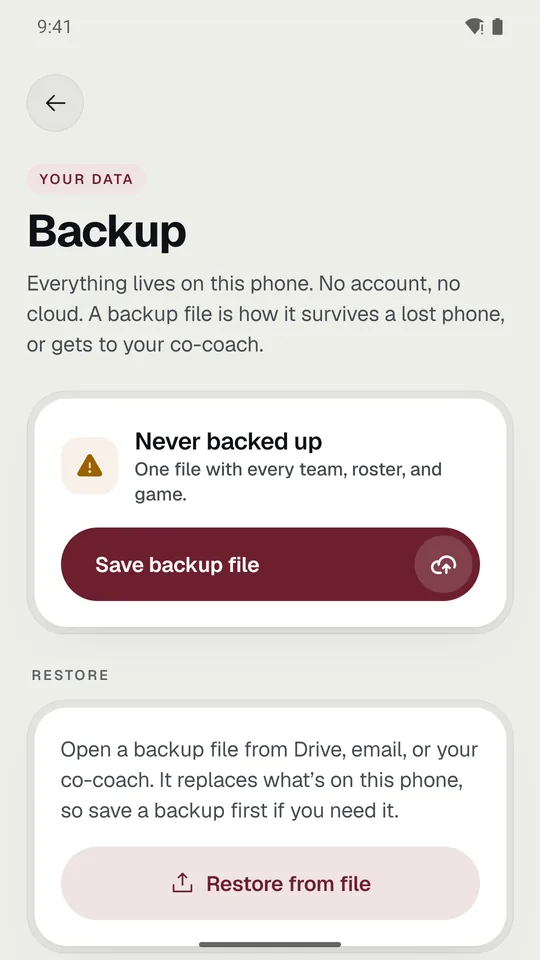
Everything lives on your phone: no account, no cloud. A backup file is how it survives a lost phone or gets to a new one.

Save a backup file

  1. Go to Team › Settings › Backup and restore.
  2. Tap Save backup file.
  3. Send it somewhere off your phone: Google Drive, email, or a message to yourself.

One file holds every team on the phone: rosters, games, plays, practices, logos, and Recently deleted. It never carries Pro; that comes back with Restore purchases.

If it’s been more than 7 days since your last backup, a finished game’s box score reminds you with Back up now. Android also keeps an automatic copy with your Google account backup, but the file is the one you control.

Backup and restore: when you last backed up, and Save backup file.

Restore from a backup

  1. Go to Team › Settings › Backup and restore and tap Restore from file. On a new phone with no team yet, tap Restore a backup on the first screen.
  2. Pick the backup file.
  3. Check what’s in it (the date, and how many teams, players, and games), then tap Replace and restore.
Note

A restore replaces everything on this phone with what’s in the file. Save a backup of this phone first if you might need what’s on it.

A backup from a newer version of Sixth Man asks you to update the app first. If anything goes wrong, nothing on the phone changes.

Get back something you deleted

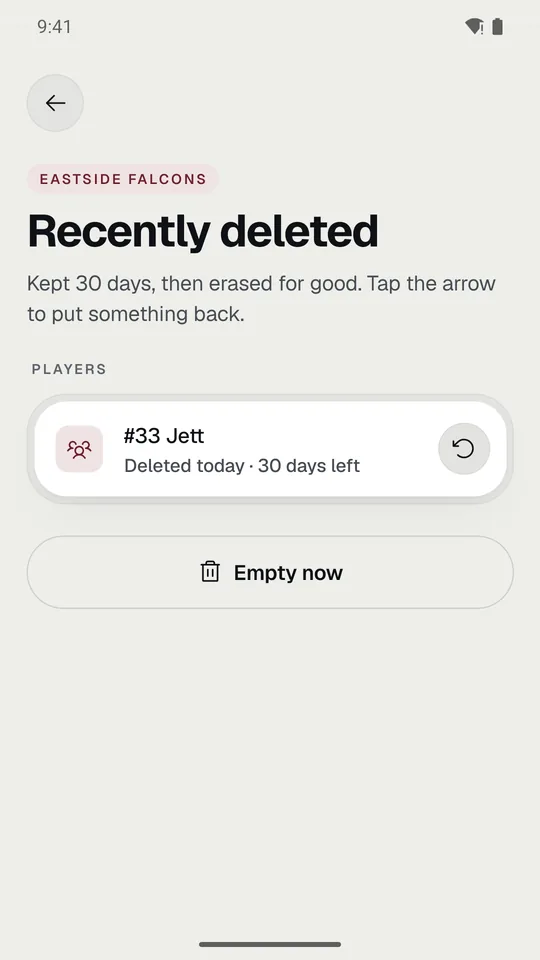
Deleted players, plays, practices, and games wait here for 30 days.

  1. Go to Team › Settings › Recently deleted.
  2. Tap the arrow next to what you want back.

Empty now, then tap again, erases everything here for good. A deleted team doesn’t go here; it’s gone for good. Recently deleted is per team, and it’s locked on demo teams.

Recently deleted: players, plays, and games kept for 30 days.

Settings and help

Find any setting fast, get help from a person, and use Sixth Man your way.

Find a setting
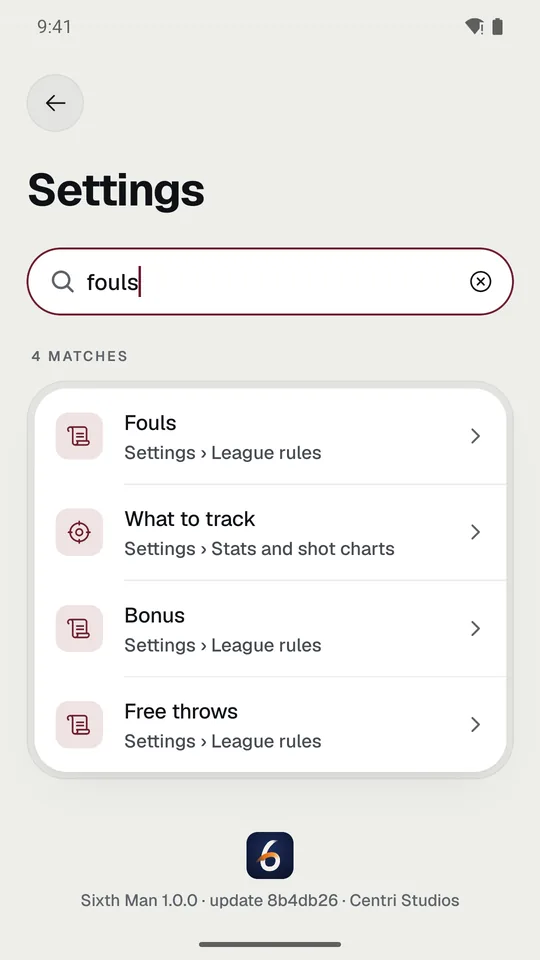
  1. Go to Team › Settings.
  2. Type in Search settings at the top, in your own words: “dark”, “bonus”, “shot chart”, “4 on 4”, “trash”.
  3. Tap a result. Its screen opens at that spot, which lights up for a moment.
Settings search: typing “fouls” finds every foul rule.

What’s in Settings

Team › Settings is grouped by what each setting is for:
PartWhat’s there
The team (This team only)Stats and shot charts, League rules, Name and colors, Recently deleted, the Features switches, and Delete this team
This phone (Every team)Appearance, and Backup and restore
Sixth ManPro, Help and feedback, the tour, the high school demo, and the app’s version at the bottom

Get help or report a problem

  1. Go to Team › Settings › Help and feedback.
  2. Your email app opens a message to us, with your app version and phone model filled in, plus a short list of recent problems the app ran into on this phone.
  3. Write what happened and send it.

Nothing is sent until you send it, and you can read everything in the message first. A person reads every email, and we reply within 2 days. You can also write to support@centristudios.com. If a screen fails to load, its Tell us what happened button sends the same email.

Open a demo team again

  • Demo Dragons (youth) and the tour: Team › Settings › Take the tour.
  • Demo Eagles (varsity, with full stats and shot charts): Team › Settings › High school demo.

Either one opens the demo you have, or makes it if you deleted it.

Use Sixth Man on a tablet

On a tablet held sideways, Sixth Man uses the room:

  • The tabs run down the left side.
  • Home adds a Season card with your record, the last game, and top scorers.
  • A game turns sideways with the roster, court, and live stats on one screen: see Keep the book on a tablet.
  • Box scores, season stats, new game, and Settings use two columns. The play builder and present mode put the court beside the controls.

Accessibility

  • Large text: Sixth Man follows your phone’s font size, and screens reflow to fit.
  • TalkBack: every button has a spoken name, like “Plus two for number 3”. Scores are announced after each basket, and plays can be read and edited: see Edit plays with a screen reader.
  • Never color alone: offense is circles and defense is X’s; hot and cold zones have ▲ and ▼; alerts have an icon and words.
  • Contrast: whatever two team colors you pick, text stays readable in light and dark mode, and the color picker warns about pairs that are hard to tell apart.
  • Reduced motion: with your phone’s setting on, decorative motion is skipped and plays start at half speed.
Didn’t find it?

Email support@centristudios.com. A person reads every message, and we reply within 2 days.

Email support